
informational Pillar guide 9 min read
The State Hall of the Austrian National Library
Updated October 2, 2026
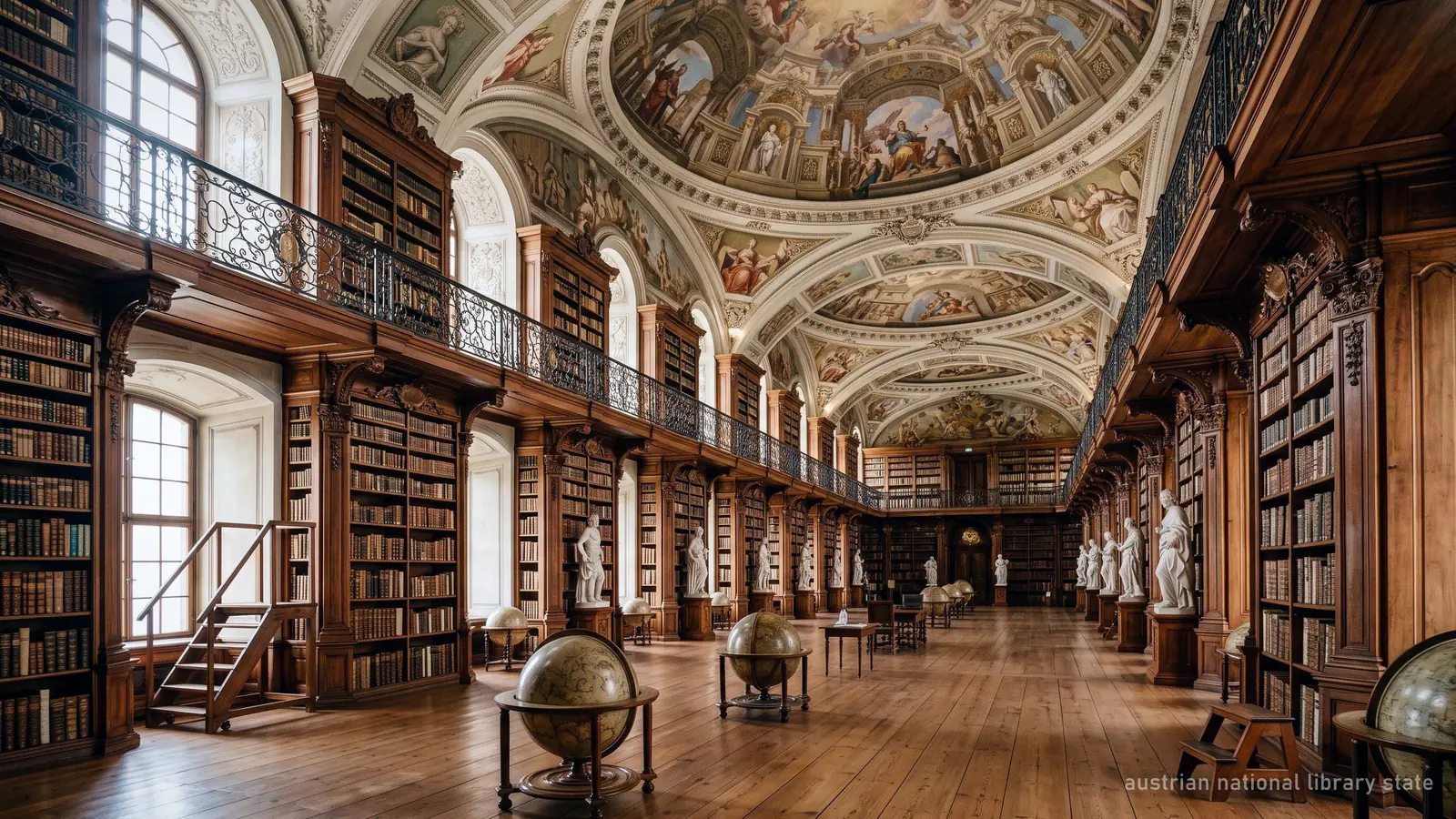
The State Hall of the Austrian National Library — the Prunksaal — is the baroque ceremonial hall of what was the imperial court library, inside the Hofburg on Josefsplatz. It is one room, it holds around 200,000 historical books, and it is the reason people who have no particular interest in libraries queue for a library.
It is also the most self-contained thing at the palace: no route, no wings, no sequence. You go in, you are in it, and the only question is how long you stay. The ticket page has the prices and hours; this page is about what you are standing in.
The institution around the room
The Austrian National Library is the largest library in Austria, with more than 12 million items across its collections, housed in the Hofburg with some holdings relocated since 2005 into the baroque Palais Mollard-Clary.
It was founded by the Habsburgs and called the Kaiserliche Hofbibliothek — the Imperial Court Library — until 1920, when the monarchy had gone and the new republic renamed it. The complex today includes four museums alongside its special collections and archives, and the smaller ones are covered on our library museums page.
The Prunksaal is the old heart of it. Everything else the institution does now happens around a room built to be looked at.
Who built it, and when
The wing was begun in 1721 by Johann Bernhard Fischer von Erlach and finished after his death in 1723 by his son, Joseph Emanuel.
That division matters and is often collapsed. Joseph Emanuel is the Fischer von Erlach who designed the Winter Riding School between 1729 and 1735 and drew the Michaelertrakt, the domed gateway most visitors arrive through. The State Hall is his father’s design, completed by him — the two men between them are responsible for most of what the Hofburg looks like from the outside.
The sculptures on the wing are by Lorenzo Mattielli. Before the hall was built, the site held the books of the Minoritenkloster, the monastery of the Conventual Franciscans.
A war side and a peace side
The hall is not one undivided space. It is organised, following the original catalogue of the books, into two opposing halves: a war side and a peace side.
That organisation is carried through into the decoration. Daniel Gran’s wall frescoes follow the same division, so the room argues with itself across its own length — an eighteenth-century library that filed its knowledge by whether it concerned making war or keeping the peace, and then painted the distinction on the walls.
Once you know it is there, the hall stops being a single overwhelming effect and becomes readable. Stand at one end and work out which half you are in.
The dome
The central dome fresco is a kind of apotheosis of Emperor Charles VI, whose image is held aloft by Hercules and Apollo. Around him, allegorical figures meet in a deliberately complicated programme symbolising the virtues of the Habsburgs and the wealth of their domains.
It is propaganda, and it is very good propaganda. The room exists to say that the family that owned these books also owned the learning in them.
There is a crack in that story, literally. During the reign of Maria Theresa the dome began to crack, and the court architect Nikolaus Pacassi strengthened the structure with an iron ring. Gran’s fresco was restored afterwards by Franz Anton Maulbertsch, and the trace of a tear from the damage can still be seen in it.
The statues and the globes
Marble statues of emperors line the hall, with Charles VI in the centre, carved by the sculptors Peter and Paul Strudel.
The four large globes are by Vincenzo Coronelli, the Venetian cosmographer whose globes are among the most ambitious objects of their kind ever made. They sit in the middle of the room and they are the thing most visitors photograph after the ceiling.
If globes interest you beyond these four, the library runs the only public museum in the world dedicated to them — the Globe Museum in the Palais Mollard on Herrengasse, holding 380 globes and scientific instruments including terrestrial and celestial globes made before 1850, on a combined EUR 6 ticket with the Esperanto Museum.
Prince Eugene’s fifteen thousand volumes
The collection in the hall was built by acquisition, and the most valuable single addition was the library of Prince Eugene of Savoy — 15,000 volumes including valuable books from France and Italy. At that point the State Hall housed about 200,000 books, which is roughly what it holds today.
The Prince Eugene acquisition prompted the first serious criticism of the whole enterprise: that the library served mainly as representation rather than as a place to look things up. Maria Theresa’s physician Gerard van Swieten and his son Gottfried supplemented the collection with scientific works in response, and Gottfried introduced the card index, which for the first time made continuous updating of the inventory possible.
So the complaint that this is a room for looking at rather than reading in is not a modern tourist’s complaint. It was made in the eighteenth century, by the court’s own doctor.
How Josefsplatz came to exist
During Maria Theresa’s reign the wing was extended at both ends, connecting the central Prunksaal to the Hofburg on one side and to the Augustinian Church on the other.
That extension is what created Josefsplatz — the enclosed baroque square the hall’s entrance opens onto, and the most complete square of its kind in Vienna. The library wing sits between Josefsplatz to the north and the Burggarten to the south, which is why the building feels like a bridge when you walk around it.
Our Josefsplatz page covers the rest of the square, including the Augustinian Church at the far end, which is free to enter and holds the hearts of 54 Habsburgs in the Loreto Chapel.
Is it free, and can you use the reading rooms?
No, and not these ones.
The State Hall is a ticketed museum: EUR 12 for an adult, EUR 10 reduced, EUR 10.50 for seniors and Vienna City Card holders, and free for everyone under 19. The reduced and free-entry questions come up constantly in search, and the answer is that there is no general free admission — although the hall is included in both the Vienna PASS and the Vienna FLEXI Pass, one visit per pass.
The reading rooms are a separate matter entirely. The library’s public reading rooms are at Heldenplatz, they are a working research facility, and they operate under their own conditions of use. The Prunksaal is a museum; the books displayed in it cannot be read. Turning up at Josefsplatz with a research question gets you a beautiful room and no catalogue.
Visiting
Open 09:00 to 18:00, and to 21:00 on Thursday. From October to May it is closed on Mondays; from June to September it opens every day. On 24 December the National Library’s museums close at 15:00; other public holidays keep regular hours. There are no timed entry slots.
The prices and hours come from the library’s own site, onb.ac.at, read on 2 October 2026. Its admission page grants holders of the Vienna PASS or the FLEXI Pass one free admission, and the Vienna PASS adds fast-track entry past the ticket desk.
Allow 30 to 60 minutes — the operator’s own guidance — and go at 09:00 if you want to photograph the room without people in it. The entrance is two minutes from where the palace museum route lets you out, which makes it the natural second stop on a Hofburg morning. More on fitting it into a day at Hofburg Palace Tickets.