
Josefsplatz: Vienna's Most Complete Baroque Square
Updated October 2, 2026
Josefsplatz is the square on the quiet side of the Hofburg, and it is generally reckoned the most complete baroque square in Vienna — an enclosed rectangle where every façade was designed to belong to the others. Four separate things you might buy a ticket for open onto it, and the square itself is free, open and usually almost empty compared with Michaelerplatz two minutes away.
Why it looks the way it does
Because one architect got to finish it. Josef Emanuel Fischer von Erlach designed the Court Library on the square's eastern side in the 1720s, and the buildings around it were composed to match — same scale, same rhythm of windows, same restrained palette. Unlike Michaelerplatz, which is a star-shaped junction where five streets collide, Josefsplatz is a room. That coherence is the reason it appears in so many period films. It is also why it feels quiet: there is no through traffic to speak of and no major entrance drawing a crowd across it.
The State Hall
The Prunksaal of the Austrian National Library, and the reason most visitors come to this square. Fischer von Erlach's baroque library hall, holding around 200,000 historical books under a painted dome, and one of the great interiors in Europe. Adult admission is EUR 12, and everyone under 19 goes free. It is open 09:00 to 18:00, and to 21:00 on Thursday; from October to May it is closed on Mondays. There are no timed entry slots. Allow 30 to 60 minutes. Those figures come from the library's own site, onb.ac.at, read on 2 October 2026. The hall is also included in both the Vienna PASS and the FLEXI Pass: one free visit, with fast-track entry on the Vienna PASS.
The Joseph II statue
In the middle of the square, and the reason for its name: an equestrian bronze of Emperor Joseph II, the reforming Habsburg who abolished serfdom, issued the Edict of Toleration and dissolved a great many monasteries — including, as it happens, having eighteen side altars removed from the Augustinian Church on this same square during its 1784 restoration. He is shown in Roman dress on horseback, in the manner of Marcus Aurelius, which is what an eighteenth-century monarch commissioned when he wanted to be taken seriously.
The Redoutensäle
The palace's ballrooms are behind the façade on the north side. They are where the Vienna Hofburg Orchestra's concerts and much of the ball season happen, and they are the only significant part of the palace that is not old. On the night of 26–27 November 1992 a large fire started here. The Great Redoutensaal was destroyed, its 1892 stucco ceiling came down and the baroque roof timbers burned. The Spanish Riding School and the National Library — both on this square — were threatened and saved. The rebuild was finished by 1997, with new wall and ceiling paintings by Josef Mikl based on texts by Raimund, Nestroy, Canetti and Kraus, rather than a reconstruction of what was lost. There is no museum ticket for these rooms. A concert or a ball is the way in; our [Redoutensäle page](/guides/redoutensaele) covers both.
The Augustinian Church
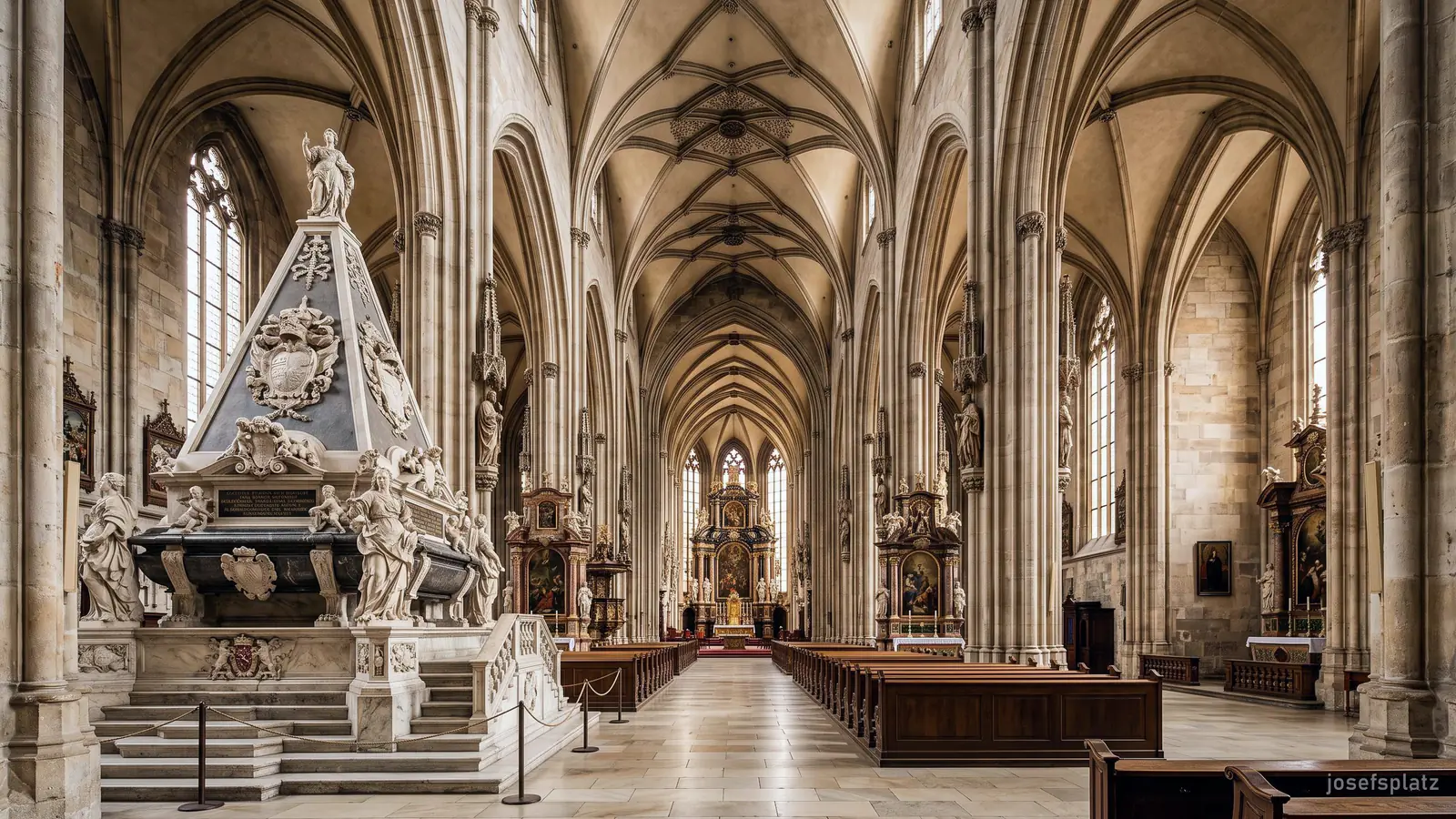
On the square's southern side, and the most-missed thing on it. A Gothic parish church founded in 1327, engulfed by the palace as it grew, and free to walk into. It was the parish church of the imperial court from 1634, which made it the family's wedding chapel: Maria Theresa married Francis of Lorraine here in 1736, Marie Louise married Napoleon in 1810, and Franz Joseph married Elisabeth on 24 April 1854. In the Loreto Chapel to the right of the main altar is the Herzgruft, holding the hearts of 54 members of the imperial family in silver urns. The parish runs a 30-minute heart-crypt tour at EUR 5 and a full church tour including it at EUR 10, per its own tours page. Canova's 1805 cenotaph to Archduchess Maria Christina is in the nave.
The stables, and a square-side walk
The Stallburg sits between Josefsplatz and Michaelerplatz, on Reitschulgasse. Built around 1558–1565 as a residence for the future Maximilian II, it later became the imperial stables and the Lipizzaner stallions live in it today — it is described as Vienna's most significant Renaissance structure. From Reitschulgasse you can see into its courtyard, with a wrought-iron fountain of 1675, for nothing. The Lipizzaner Museum that used to stand next to it has closed. The Winter Riding School, where the horses perform, is the other half of the same complex and opens onto this square too. A fifteen-minute circuit that costs nothing: start at Michaelerplatz, walk down Reitschulgasse past the Stallburg yard, come out into Josefsplatz, go into the Augustinian Church, and leave towards the Albertina and the Burggarten.
Frequently asked questions
What is on Josefsplatz?
The State Hall of the Austrian National Library, the Redoutensäle, the Augustinian Church, the Winter Riding School and the Stallburg stables, plus the equestrian statue of Joseph II.
Is Josefsplatz free to visit?
Yes. The square itself is open public space, and the Augustinian Church on it is free to enter. The State Hall is a ticketed museum at EUR 12.
How do I get to Josefsplatz?
It is inside the Hofburg complex. Herrengasse (U3) is the nearest station, about 320 m; from Michaelerplatz walk down Reitschulgasse past the Stallburg.
Where are the Habsburg hearts kept?
In the Herzgruft, in the Loreto Chapel of the Augustinian Church on Josefsplatz: 54 hearts in silver urns.
Sources