
informational 6 min read
The Augustinian Church Inside the Hofburg
Updated September 18, 2026
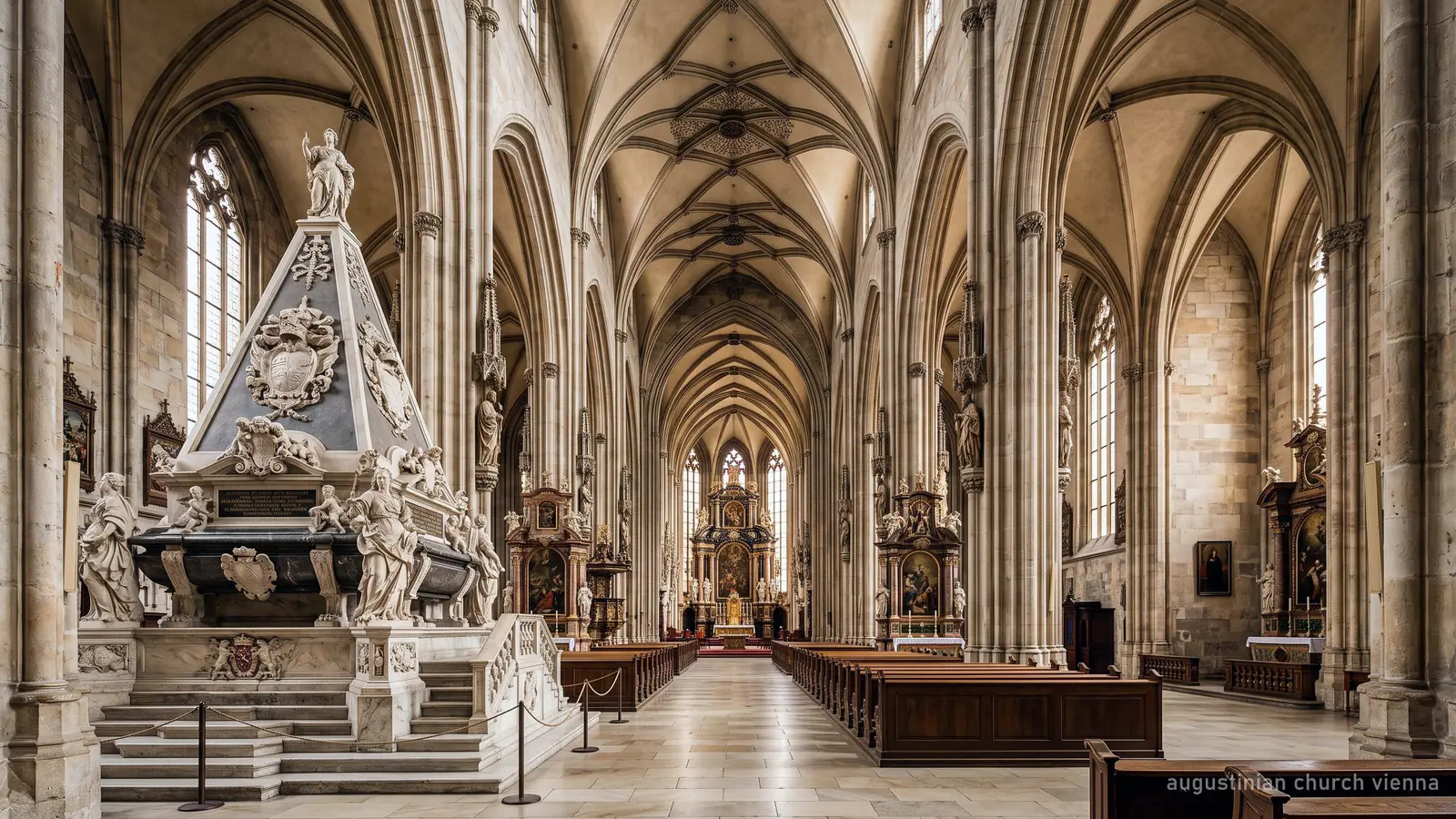
There is a Gothic parish church inside the Hofburg, on Josefsplatz, and it holds the hearts of fifty-four Habsburgs in silver urns. It is free to walk into, most visitors pass the door without noticing it, and it is where Franz Joseph married Elisabeth in 1854.
A church swallowed by a palace
Duke Frederick the Handsome founded it in 1327, with a cloister for the Augustinian friars. The nave was built by the architect Dietrich Landtner between 1330 and 1339 and consecrated on 1 November 1349.
Then the Hofburg grew around it. As the palace expanded the Augustinerkirche was gradually engulfed, and today it is part of the complex — which is why it is inconspicuous from outside and startling inside. It is 85 m long and 20 m wide, with an 11 m nave, and the interior is far more ornate than the street front suggests.
In 1634 it became the parish church of the imperial court, and that is what made it matter.
The weddings
Being the court’s parish church meant being the family’s wedding chapel, and the list is a summary of European dynastic politics:
- Archduchess Maria Theresa to Duke Francis of Lorraine, 1736 — the marriage that made every later emperor a Habsburg-Lorraine.
- Archduchess Marie Louise to Emperor Napoleon Bonaparte, 1810.
- Maria Leopoldina to Dom Pedro of Portugal, 1817 — who became the first Emperor of Brazil.
- Emperor Franz Joseph to Duchess Elisabeth in Bavaria, 24 April 1854.
That last one is two minutes’ walk from the museum built about her. If you have done the Sisi Museum and not seen this church, you have seen where the marriage happened but not where it started.
The Herzgruft
To the right of the main altar is the Loreto Chapel, and inside it the Herzgruft — the heart crypt. It holds silver urns containing the hearts of 54 members of the imperial family.
This is one third of the Habsburg custom of divided burial. For roughly a third of those entombed in the Imperial Crypt, the heart was removed during embalming and placed in a silver urn and sent here; the intestines and other organs went into copper urns in the Ducal Crypt beneath St Stephen’s Cathedral; the body went to the Kaisergruft on the Neuer Markt.
Three buildings, all within ten minutes of each other. Walking between them in that order is the clearest way to understand what this family thought a death was, and almost nobody does it.
You can go in. The parish offers a guided tour of the heart crypt alone, lasting about 30 minutes, at EUR 5 per person, and a full church tour including the heart crypt, about an hour, at EUR 10. On Sundays and public holidays a tour is offered after the Hochamt, starting in the Loreto Chapel and announced at the end of mass; on weekdays it is by arrangement with the parish. Those are the prices published on the church’s own tours page, read on 18 September 2026.
Canova’s cenotaph
The other object people come for. Antonio Canova sculpted the memorial to Archduchess Maria Christina of Austria in 1805 — a marble pyramid with a procession of mourners walking into its open door.
It is one of the most reproduced funerary monuments in Europe and it is standing in a free-entry parish church that most Hofburg visitors never open the door of.
The music
This is a serious musical church, not an incidental one. Franz Schubert conducted his Mass in F major here. Anton Bruckner’s Mass in F minor was written for this church and first performed in it.
The tradition continues: the church is known for its weekly Sunday High Mass with full orchestra and choir, and it has two organs. That is a second orchestral mass inside the Hofburg complex every Sunday, alongside the Vienna Boys’ Choir in the Hofburgkapelle — two courtyards apart, both essentially free to attend.
Check the parish’s own schedule for times before you plan around it.
Visiting
Entry to the church is free; it is a working parish, not a museum. The pulpit of 1784–85 by Johann Ferdinand Hetzendorf von Hohenberg is an early piece of Gothic Revival worth looking up at, and a side altar dedicated to Emperor Karl I was added in 2004.
A monastery of six Augustinian friars still serves the parish. Behave accordingly: this is a place of worship first, and the hearts in the Loreto Chapel are family remains, not an exhibit.