
informational Pillar guide 8 min read
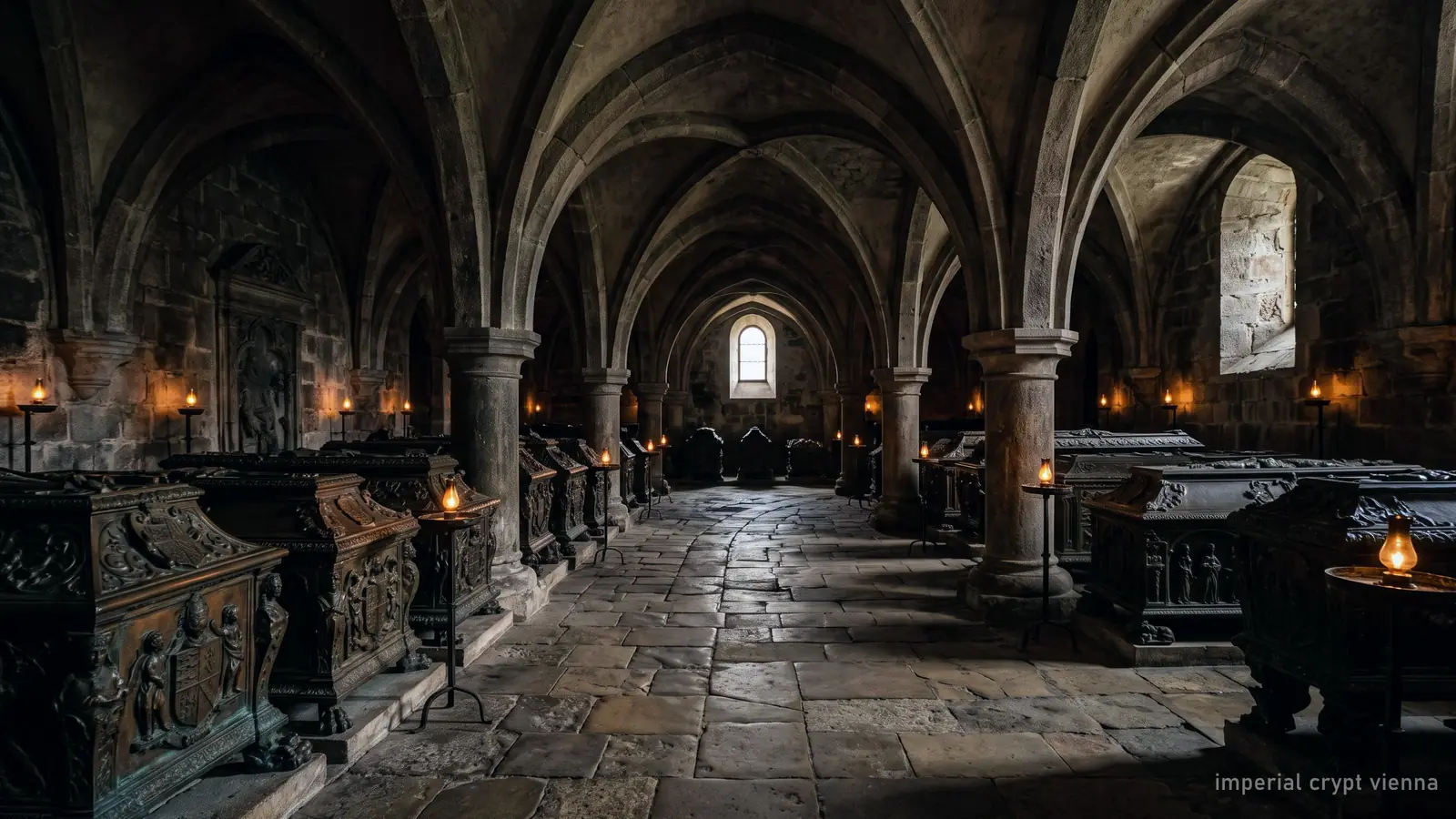
The Imperial Crypt (Kaisergruft) in Vienna
Updated September 18, 2026
The Imperial Crypt is not part of the Hofburg. It sits under the Capuchin church on the Neuer Markt, about five minutes’ walk from the palace, and it is where the Habsburgs were actually buried — including Empress Elisabeth, whose museum is back in the palace you have just left. Visitors who do the Sisi Museum and go home have seen the story and missed the grave.
The church and the crypt beneath it
Anna of Tyrol, wife of Emperor Matthias, came up with the idea: a Capuchin cloister and burial crypt for herself and her husband, near the Hofburg. She provided the funds in a will made on 10 November 1617 and died the following year, which released them. Her husband died in 1619.
The foundation stone was laid on 8 September 1622, the Thirty Years’ War slowed everything down, and the church was dedicated on 25 July 1632. At Easter 1633 the coffins of Matthias and Anna were carried into what is now the Founders Vault. Since then it has been the principal burial place of the House of Habsburg.
It grew by accretion. Leopold I extended it under the nave in 1657; Joseph I pushed west in 1710; Charles VI continued in 1720, bringing in Lukas von Hildebrandt — the first well-known architect to work on it. In 1754 Maria Theresa went further west still, out past the church above and into the monastery garden, with a domed chamber by Jean Jadot de Ville-Issey that lets daylight in. Franz Joseph added another chamber in 1908, for his sixtieth jubilee. A New Vault was built by 1960 to get the humidity under control, adding about a fifth to the space.
Ten interconnected vaults, and the visitor route no longer doubles back on itself: a 2003 project opened doors that had never been used and made the crypt accessible to disabled visitors at the same time.
Who is down there
The two authorities give slightly different counts, and both are worth having.
| Source | Bodies | Emperors | Empresses |
|---|---|---|---|
| The Capuchins’ own site | “150 Habsburg personalities” | 12 | 22 empresses and queens |
| Wikipedia | 145 bodies, plus urns for four others | 12 | 18 |
The difference is mostly a question of what gets counted — urns, spouses from other families, and the difference between an empress and a queen. What both agree on is the shape of the thing: twelve emperors, and about a hundred and fifty people.
The visible sarcophagi number 107, with five heart urns, and they run from puritan plain to full rococo. Thirty-three of the people buried here came from families other than the Habsburgs, and more than a quarter of everyone entombed was five years old or younger when they died.
There is only one space left.
Maria Theresa’s double sarcophagus
The one people photograph. Maria Theresa and her husband Francis Stephen lie together under a lid weighing around 1,700 kg — the tombs are braced with iron and lined with wood inside to stop them caving in or buckling under their own covers. It sits in the domed chamber she built for it in 1754, the only part of the crypt with natural light.
Franz Joseph, Elisabeth and Rudolf
Three graves side by side, in the chamber Franz Joseph built in 1908 without knowing it would end up holding him. His son Rudolf died at Mayerling in 1889; his wife Elisabeth was murdered in Geneva in 1898 and carried here on 17 September, with eighty-two sovereigns and high nobles following the cortege; he died at Schönbrunn in 1916 and was brought down to join them.
For a great many visitors this is the reason to come. The Sisi Museum tells you about her life; this is the end of it.
The split burial
The Habsburgs divided their dead across three Vienna churches, and the Hofburg holds one of the three.
Bodies went into the Kaisergruft. For about a third of them, the heart was placed in a silver urn and sent to the Herzgruft in the Augustinerkirche — which is inside the Hofburg complex, on Josefsplatz. The intestines and other organs went into copper urns in the Ducal Crypt in the catacombs of St Stephen’s Cathedral.
So an emperor can be in three buildings at once, two of which you can walk between in four minutes.
The coffins themselves usually have two locks. One key is held by the Capuchin Guardian of the crypt. The other is kept in the Treasury of the Hofburg.
Still in use
The most recent entombment was on 7 October 2023: Archduchess Yolande of Austria, wife of Archduke Carl Ludwig, who died at 100 years and 5 months — the longest-lived person buried here. The next longest-lived is Otto von Habsburg, eldest son of the last emperor, who died at 98 and was buried here in 2011.
Tickets, hours and where it is
Read from the crypt’s own visitor page on 18 September 2026:
| Ticket | Price |
|---|---|
| Adult | EUR 15.00 |
| Reduced | EUR 13.00 |
The reduced rate applies to holders of the Vienna City Card, the Vienna PASS, the Flexi Pass and the Kulturpass, among others. The Imperial Crypt is also on the Vienna PASS’s own list of included sights, where the pass covers entry outright.
Open daily 10:00 to 18:00, last admission 17:30. The address is Tegetthoffstraße 2, on the Neuer Markt, 1010 Vienna.
How to fit it into a Hofburg day
It is the natural second stop after the Imperial Apartments and the Sisi Museum, and the walk takes about five minutes: out at Michaelerplatz, along the Kohlmarkt, right at the Graben and down to the Neuer Markt. Allow forty minutes inside. It is a working religious site, quiet, and a dozen Capuchin friars still look after it — behave as you would in a church.