
informational Pillar guide 8 min read
Emperor Franz Joseph I of Austria
Updated September 18, 2026
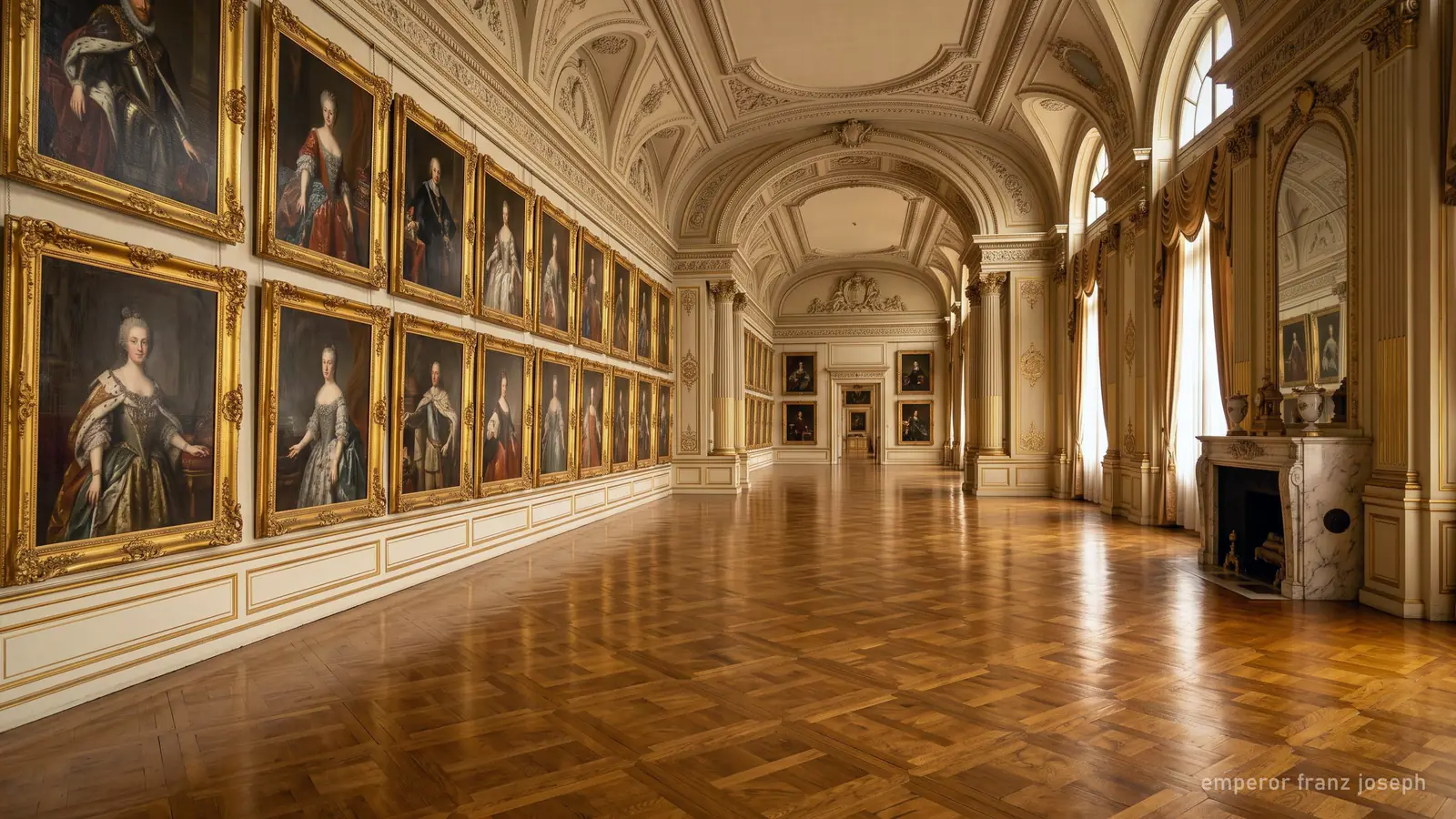
Franz Joseph I ruled Austria for sixty-eight years, from December 1848 until his death in November 1916. He came to the throne at eighteen and left it at eighty-six, and the Hofburg’s Imperial Apartments are his working rooms: the desk, the iron camp bed, the office of a man whose job was paperwork.
The accession
Born 18 August 1830. In December 1848, with the Hungarian Revolution still running, his uncle Emperor Ferdinand I abdicated at Olomouc as part of Minister President Schwarzenberg’s plan to end it. Franz Joseph took the throne on 2 December, aged eighteen.
He spent the early part of the reign resisting constitutionalism in every one of his territories, and is generally read as a reactionary. He was also, from the start, unlucky in war. Austria lost its influence over Tuscany and most of its claim to Lombardy–Venetia to Sardinia after the Second Italian War of Independence in 1859, and lost again in 1866. It ceded no territory to Prussia after the Austro-Prussian War, but the Peace of Prague settled the German question in Prussia’s favour — which meant Germany would not be unified under the Habsburgs.
In 1867 he concluded the Austro-Hungarian Compromise, granting Hungary far greater autonomy and creating the dual monarchy of Austria-Hungary. That bought him forty-five comparatively peaceful years.
The 1853 attempt
On 18 February 1853 a Hungarian nationalist named János Libényi came up behind him on a city bastion while he was walking with one of his officers and struck at his neck with a knife.
Franz Joseph almost always wore uniform, and the uniform collars of the period were made of very sturdy material for exactly this reason. He was wounded and bleeding, but the collar saved his life. Count O’Donnell cut Libényi down with his sabre; a butcher named Joseph Ettenreich, who happened to be nearby, overpowered him. Both men were ennobled. Libényi was executed.
His brother Maximilian then asked the royal families of Europe to fund a church on the site as a votive offering for the emperor’s survival. That is the Votivkirche, on the Ringstraße near the university.
The routine
The detail everyone repeats about Franz Joseph is that he rose before dawn and worked. The best evidence for it is also the last thing he ever said. Dying at Schönbrunn on the evening of 21 November 1916, he told his valet: “Tomorrow morning, at half past three.” Sick with pneumonia at eighty-six, he still intended to get up at his usual time.
That is the man the Imperial Apartments are furnished to show. He treated the imperial office as an administrative post and kept the habits of a civil servant for nearly seven decades.
The marriage
The court wanted him married. His mother, Archduchess Sophie, wanted a Wittelsbach alliance and had picked her sister Ludovika’s eldest daughter, Helene. Franz Joseph met Helene’s fifteen-year-old younger sister Elisabeth, fell in love, and insisted. They married on 24 April 1854 in St Augustine’s Church — the Augustinerkirche, which stands inside the Hofburg complex on Josefsplatz.
It did not work. He was passionately in love with her and the feeling was not returned. Elisabeth never acclimatised to court life and was constantly in conflict with the imperial family. They had four children: Sophie, who died as an infant, Gisela, Rudolf and Marie Valerie. She travelled almost constantly and was rarely seen in Vienna.
From 1885 he had a companion: Katharina Schratt, a leading actress of the Vienna stage, who became his friend and confidante for thirty-four years. The relationship was tolerated to a degree by Elisabeth, and by all accounts remained platonic. He built Villa Schratt for her in Bad Ischl.
Four deaths
The reign was long enough for the family to be taken apart around him.
His brother Maximilian, installed as Emperor of Mexico, was executed in 1867. His only son Rudolf killed himself at Mayerling in 1889. Elisabeth was murdered by an anarchist in Geneva in 1898. His nephew and heir presumptive, Franz Ferdinand, was assassinated at Sarajevo on 28 June 1914.
Of Elisabeth’s death, an observer at the funeral wrote that “it was pitiful to look at the Emperor, he showed a great deal of energy in his immense pain, but at times one could see all the immensity of his grief.” He told his relatives: “You’ll never know how important she was to me.”
Of Franz Ferdinand’s, whom he had never forgiven for marrying a countess rather than a dynast, he said something colder to his daughter: “For me, it is a relief from a great worry.”
The war
Sarajevo led directly to Austria-Hungary’s declaration of war on Serbia, an ally of Russia, which triggered the alliance system and produced the First World War. Franz Joseph signed it off. He died two years into it, on 21 November 1916, of pneumonia in the right lung, several days after catching cold on a walk in Schönbrunn Park with King Ludwig III of Bavaria.
He was succeeded by his grand-nephew Charles I, who lasted two years before the empire collapsed.
What survives of him in the Hofburg
Not the room he died in — that was at Schönbrunn, on the other side of the city. What the Hofburg holds is the working half of his life:
- The Imperial Apartments, his and Elisabeth’s rooms in the Reichskanzleitrakt and the Amalienburg, including his study and the famous iron bed.
- The Augustinerkirche on Josefsplatz, where he married Elisabeth in 1854 — and where, by Habsburg custom, the hearts of the dynasty are kept in the Herzgruft.
- The Hofburgkapelle, whose choir sang at court throughout his reign and still sings the Sunday mass.
He is buried in the Imperial Crypt on the Neuer Markt, five minutes’ walk away, between Elisabeth and Rudolf, in the chamber he had built for his sixtieth jubilee in 1908.