
Michaelerplatz: The Hofburg's Front Door
Updated September 18, 2026
Michaelerplatz is the square most visitors arrive at, because the domed gateway on its south side is the main entrance to the Imperial Apartments, the Sisi Museum and the Silver Collection. It is a baroque, star-shaped square where the Kohlmarkt, the Herrengasse, the Schauflergasse and the Reitschulgasse meet, and it is named after the church on its eastern side. Stand in the middle of it and you can see 1,800 years of Vienna at once.
The Michaelertrakt and the entrance beneath it
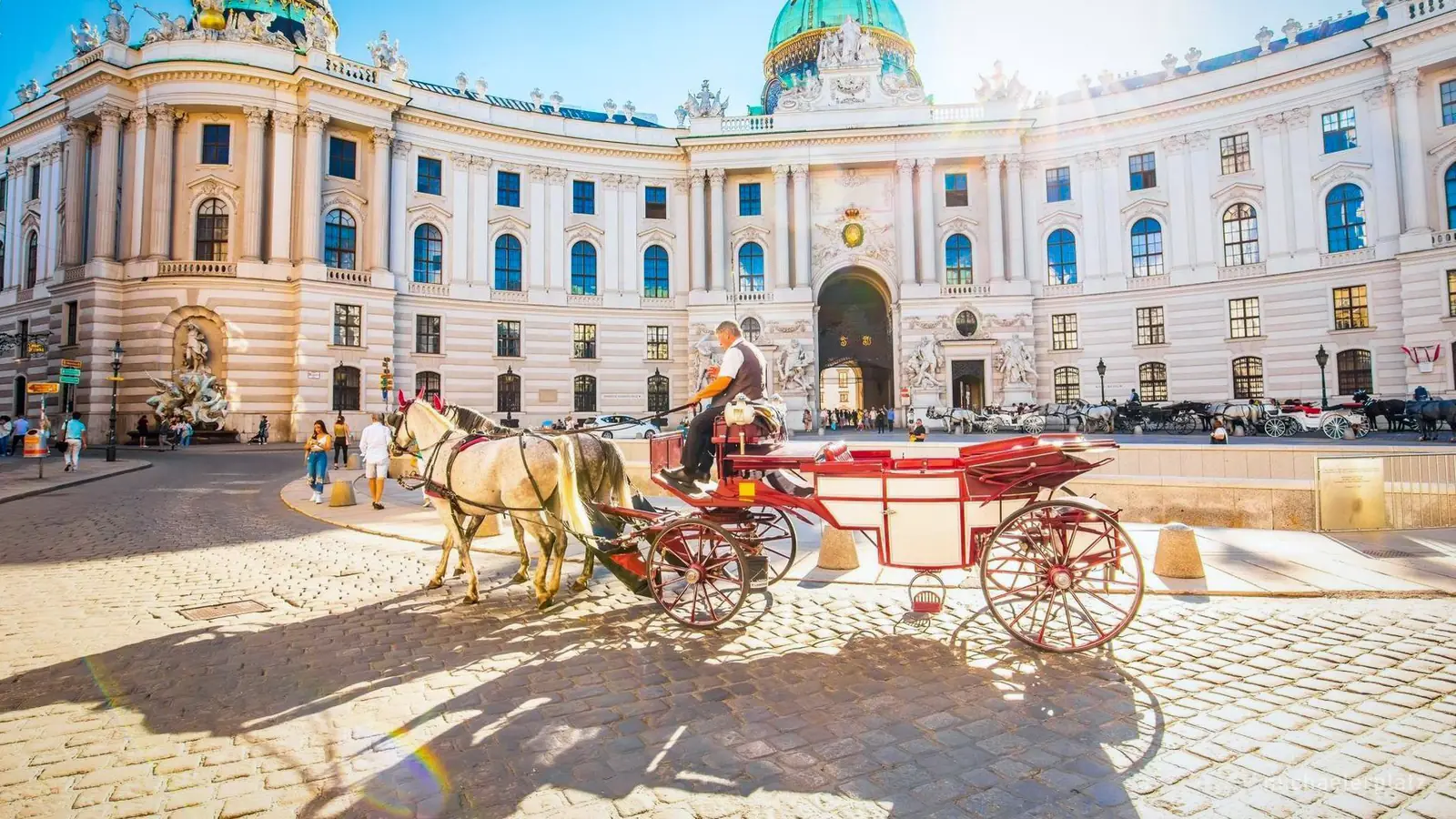
The curved wing with the green dome is the Michaelertrakt — St Michael's Wing — and the gateway through it, the Michaelertor, is where you go in for the palace museums. It took a very long time to build. Joseph Emanuel Fischer von Erlach drew the plans in the eighteenth century for a new baroque façade facing the inner city, on the ground of the palace gardens. Construction started and then stopped: the façade stayed unfinished and so did the gate, because the Old Burgtheater, which was supposed to be demolished to make room, was left standing instead. The status quo held for over a century. Only during the building of the Ringstraße in the late nineteenth century were the theatre and several houses on the western side pulled down and Fischer von Erlach's design finally completed. So the square's grandest element is a baroque design executed by Victorians, and the entrance you walk through was drawn roughly 150 years before it was finished.
The excavation in the middle
The sunken area at the centre of the square is not a fountain that stopped working. It is an archaeological excavation, and it goes back to the Roman legionary camp of Vindobona. The site sat outside the camp walls, in the civilian suburb, at the meeting point of three roads: the Limes road running along the Danube, a trade route towards modern St Pölten, and a feeder road to the camp's south-western gate. Four Roman houses dating from the second to the fifth century AD were found here, thought to have housed an entertainment quarter with a small shop among them. Later medieval remains are exposed alongside them. It is free, it is open to the air, and most people walk straight past it on the way to the ticket desk.
The Loos House
The flat, unornamented building facing the palace across the square is the Looshaus, also called the Goldman & Salatsch Building, at Michaelerplatz 3. Adolf Loos designed it and it was completed in 1912; it is one of the founding buildings of Viennese modernism. It caused a scandal. The lower commercial floors are clad in green Cipollino marble from Euboea with a colonnade of Tuscan columns, deliberately answering the portico of St Michael's Church opposite. The residential storeys above are bare plaster with no ornament at all, and in 1910 the city would only let construction continue after Loos added window boxes to soften what one newspaper called their 'inappropriate nakedness'. Another called the building a dung heap. Loos defended it in public lectures. The story everyone tells is that Emperor Franz Joseph disliked it so much that he ordered the curtains on the Hofburg windows facing the square kept closed. The sources record it as a report rather than a documented fact, so treat it as the excellent anecdote it is. What is certain is that the two buildings face each other across eighty metres and about two hundred years of argument about what a façade is for.
St Michael's Church
On the eastern side, and one of the oldest churches in Vienna: late Romanesque in its bones, with a neoclassical façade added later. It was built in the thirteenth century on this site and had a cemetery attached, which is how the square came to exist at all. It is free to enter, it is usually quiet even when the square is not, and it has a crypt with preserved burials that is shown on guided tours. The Habsburg connection is indirect but real — this was the court parish church.
The fiaker rank
The horse-drawn carriages line up along the square, and they are part of the scene rather than an intrusion on it: Michaelerplatz has been a traffic intersection since the Romans, and in 1927 it became Vienna's first car roundabout. A fiaker is a ride, not transport. Fares are agreed with the driver before you get in, the standard circuits are short, and nothing in the Hofburg is far enough away to need one. If you want it, want it as an experience. The rank is also the reason the square smells the way it does on a hot afternoon.
What else is on the square
Two eighteenth-century apartment houses, the Großes and Kleines Michaelerhaus, stand on the square; the larger was home at different times to Joseph Haydn, the court poet Pietro Metastasio and the piano maker Ludwig Bösendorfer. The Palais Herberstein, a neo-baroque palace built to echo the Michaelertrakt, held the Café Griensteidl, one of the great literary cafés of fin-de-siècle Vienna. The Spanish Riding School's visitor entrance is a few steps away on the same square, which makes Michaelerplatz the collection point for three separate imperial attractions.
Michaelerplatz on WikipediaThe Looshaus on Wikipedia
Frequently asked questions
Is Michaelerplatz the entrance to the Hofburg?
It is the main one for visitors. The gateway under the green dome, the Michaelertor, leads to the Imperial Apartments, the Sisi Museum and the Silver Collection.
What are the ruins in the middle of Michaelerplatz?
An archaeological excavation of the Roman civilian settlement outside the legionary camp of Vindobona, including four houses dating from the second to the fifth century AD, plus medieval remains.
Why is the Looshaus famous?
Adolf Loos completed it in 1912 with unornamented upper storeys that scandalised Vienna. The city only allowed construction to finish after he added window boxes.
How much is a fiaker ride from Michaelerplatz?
Agree the fare with the driver before you get in; the rank does not publish a fixed tariff. Nothing in the Hofburg is far enough away to need one.
Sources