
informational 6 min read
The National Library's Other Museums in Vienna
Updated October 2, 2026
Most visitors meet the Austrian National Library once, in the State Hall on Josefsplatz, and assume that is the whole of it. It runs four more museums, three of them within a few minutes’ walk of the Hofburg, and two of them cost six euros.
They are small, they are quiet, and one of them is the only museum of its kind anywhere.
The four, with prices
The prices below are the library’s own, read on its admission-fees page at onb.ac.at on 2 October 2026. The hours are the ones published on the Vienna PASS’s sight pages, read on 18 September 2026.
| Museum | Adult | Children | Where |
|---|---|---|---|
| Globe and Esperanto Museums (combined ticket) | EUR 6 | Free | Palais Mollard, Herrengasse 9 |
| Papyrus Museum | EUR 6 | Free | Neue Burg, Heldenplatz |
| Literature Museum | EUR 9 | Free | Johannesgasse 6 |
All three keep the same hours: closed Monday, open 10:00 to 18:00 Tuesday, Wednesday, Friday, Saturday and Sunday, and 10:00 to 21:00 on Thursday. The Thursday evening is the useful one — almost nothing else in this part of Vienna is open at eight.
The Globe Museum, the only one of its kind
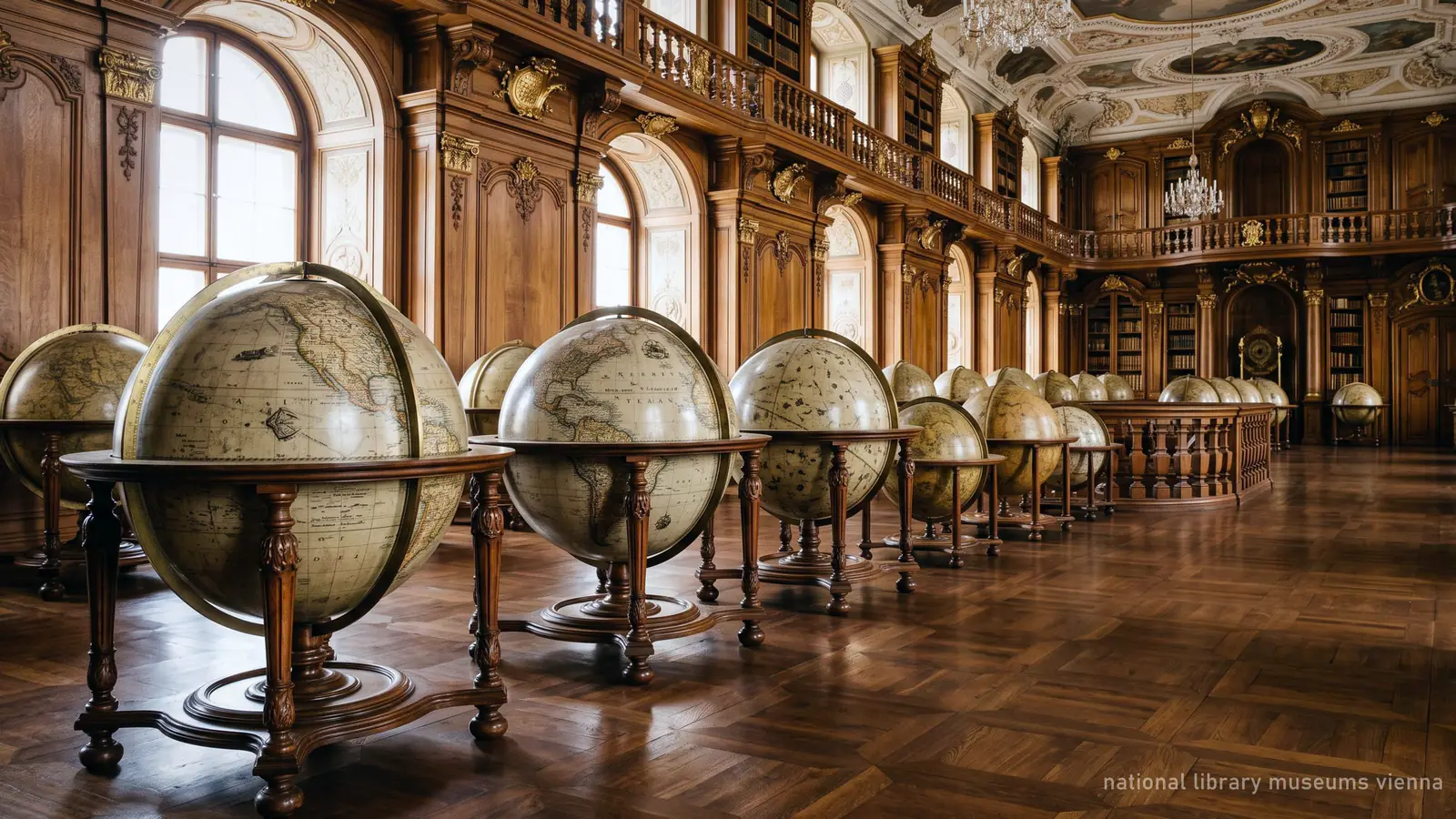
It is the only public museum in the world dedicated to globes, which is the sort of claim that sounds like marketing until you go looking for a second one and cannot find it.
The collection covers terrestrial and celestial globes, armillary spheres and planetaria, from the sixteenth century onwards. What makes it work as an exhibition rather than a storeroom is that globes are documents of what people believed the world looked like on the day they were made, so walking the rooms in order is walking through four centuries of being confidently wrong in different ways.
It shares its building, the Palais Mollard on Herrengasse, and its ticket with the Esperanto Museum. Herrengasse is also the U3 station nearest the Hofburg, so this is genuinely two minutes off the route.
The Esperanto Museum
A museum of constructed languages, attached to a collection that documents Esperanto and around 500 other invented tongues. It is one room and it will take you twenty minutes. Whether that is a good use of twenty minutes depends entirely on whether the idea of a planned international language strikes you as touching or absurd; the museum makes a decent case that it is both.
Since it shares the six-euro ticket with the globes, there is no reason to choose between them.
The Papyrus Museum
In the Neue Burg on Heldenplatz, which puts it in the same building as the Weltmuseum and the Ephesos Museum — although it is a separate operator and a separate ticket.
The collection is one of the largest papyrus holdings in the world, built largely on Egyptian material acquired in the nineteenth century, and the exhibition uses it to show what survives of everyday writing from antiquity: letters, contracts, school exercises, shopping lists. It is the most affecting of the four, because the documents are so relentlessly ordinary.
The Literature Museum
The largest of the four and the only one priced above six euros, at EUR 9, and it sits slightly apart from the others at Johannesgasse 6, a few minutes east of the palace.
It covers Austrian writing from the eighteenth century to the present across roughly 650 exhibits from more than 200 authors, with over 60 multimedia stations and its own cinema room. The names it is built around are Nestroy, Schnitzler, Kafka, Aichinger, Bachmann, Bernhard and Mayröcker.
Two objects justify the ticket on their own: a manuscript leaf from Kafka’s unfinished novel Der Verschollene — the only leaf of the Prague author’s work held in Austria — and the original letters between Ingeborg Bachmann and Paul Celan.
Which is worth a detour
Honestly: for most visitors, none of them, and that is fine. The State Hall is the one to see, and it is a different order of experience.
If you have a spare hour and one of these appeals, the ranking we would give is the Globe Museum first, because it is genuinely unique and two minutes from the U-Bahn you are already using; the Literature Museum second, if you read German literature; and the Papyrus Museum third, unless antiquity is your subject, in which case it moves to the top.
The reading rooms
A common confusion, so worth stating plainly: the reading rooms are not part of any of this. The library’s public reading rooms are at Heldenplatz and can be used under the library’s own conditions of use, but they are a working research facility, not a sight. The State Hall is a museum, and the books displayed in it cannot be read.