
informational 5 min read
The Winter Riding School at the Hofburg
Updated September 18, 2026
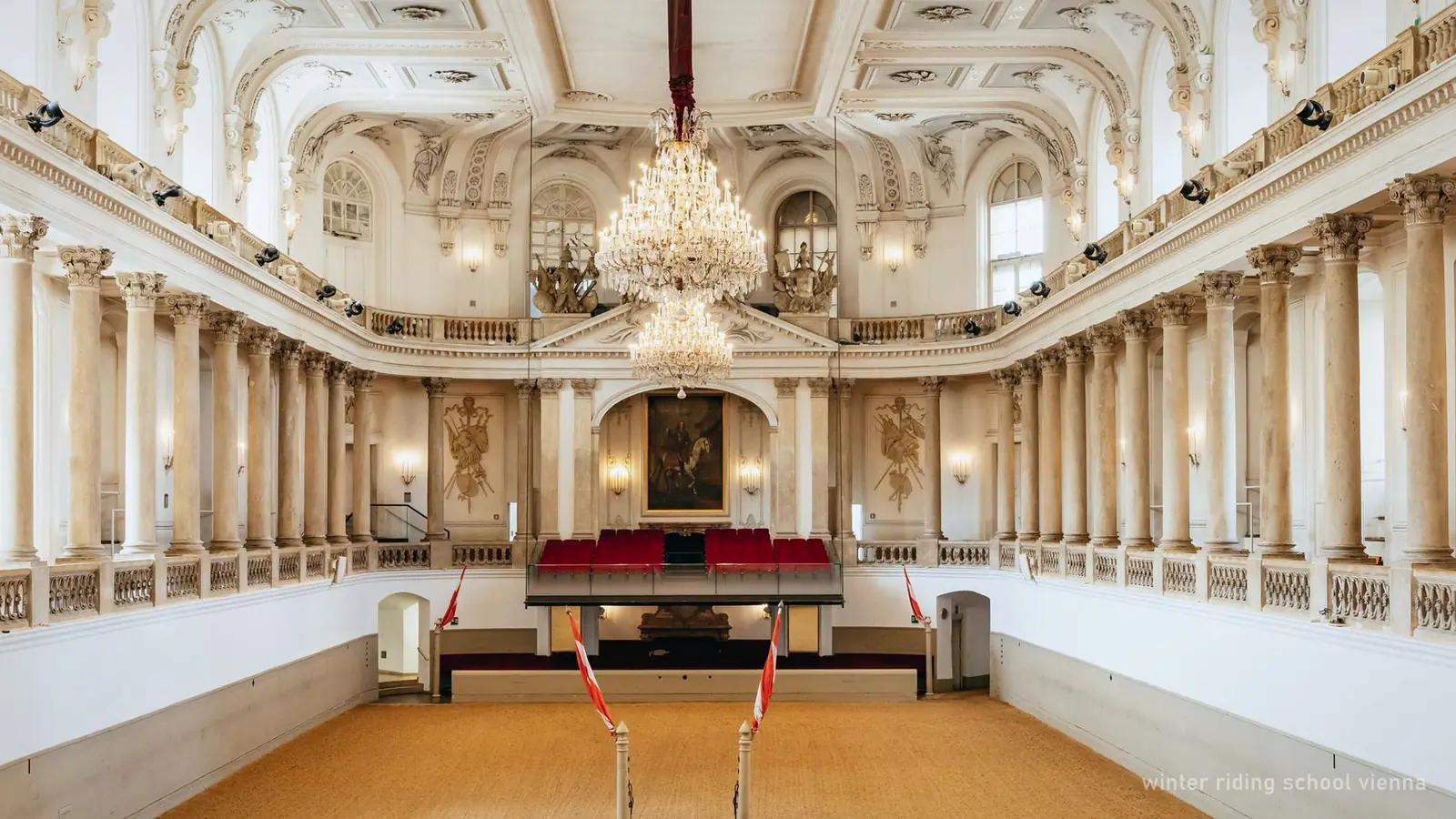
The Winter Riding School is the white hall inside the Hofburg where the Lipizzaners perform, and it is one of the great baroque interiors in Europe. It was finished in 1735, it measures 55 metres by 18 and stands 17 metres high, and it was built for exactly the purpose it still serves.
Fischer von Erlach’s hall
Emperor Charles VI commissioned it in 1729 from Joseph Emanuel Fischer von Erlach, and it was completed in 1735. Before that the school worked out of a wooden arena at Josefsplatz; records show a wooden riding arena on the site as far back as 1565.
The hall is mainly white, with some beige and light grey, galleried on two levels, and lit by chandeliers. There is no decoration competing with the floor. That restraint is the design working: everything in the room directs attention downwards, to the sand.
For a period it was used for other ceremonies. Today it is open to the public for training sessions and performances.
The portrait, and the salute
Above the royal box, opposite the entrance, hangs a portrait of Emperor Charles VI — the man who built the room.
Every rider salutes it before riding. That is the single detail that most reliably surprises first-time visitors: an institution that has outlived its empire by more than a century still begins each session by acknowledging the emperor who paid for the building.
It is not nostalgia for the monarchy so much as professional continuity. The school was first named in 1565, which makes it the oldest of its kind in the world, and the salute is part of the same unbroken practice as the training method.
What happens in it
Three things, and they are different products at different prices. The school’s own from-prices, read on 18 September 2026:
| What | From | Length |
|---|---|---|
| Performance | EUR 26 | About 45 or 70 minutes |
| Morning exercise | EUR 17 | About 60 minutes |
| Guided tour | EUR 24 | About 60 minutes |
| Architectural tour | EUR 26 | About 80 minutes |
The performance is the rehearsed programme with the airs above the ground. The morning exercise is the stallions’ daily schooling, watched from the gallery — the same hall, no choreography, nine euros less.
Seeing it without a performance ticket
Yes, and it is the reason this page exists. The 55-minute guided tour from EUR 24 takes you into the Winter Riding School and the Stallburg, the Renaissance building opposite where the stallions are stabled, and it runs independently of the performance calendar.
That matters in July and August, when all sixty-eight resident stallions go to the summer stables at Heldenberg for seven weeks and there may be nothing in the hall to watch. The tour still runs.
Two restrictions to know before booking: photography is not permitted, and children under three are not admitted. The operator also states that guided tours are not accessible by wheelchair.
There is an architectural tour as well, from EUR 26 and about 80 minutes, which trades breadth for a climb up into the 250-year-old baroque roof structure and a view from a hidden window reached by a ladder. It is limited to ten people and the operator asks for shoes you can climb in.
The stables opposite
The Stallburg, between Josefsplatz and Michaelerplatz, was built around 1558–1565 as a residence for the future Emperor Maximilian II and later became the imperial stables. It is described as Vienna’s most significant Renaissance structure, and the Lipizzaners live in it.
From Reitschulgasse you can see into the courtyard, with its wrought-iron fountain of 1675, for nothing at all. It was bombed in 1945, just before the end of the war, and faithfully restored in 1947–48; the arcaded passage between the Hofburg and the Stallburg opened on 1 July 1948.
The Lipizzaner Museum that used to be next to it has closed. The guided tour is what replaced it, and it is better.
Where it is
Between Michaelerplatz and Josefsplatz, inside the Hofburg. The visitor centre and ticket collection are on Michaelerplatz; the nearest U-Bahn is Herrengasse on the U3, about 320 metres away.