
informational Pillar guide 10 min read
The Spanish Riding School in Vienna
Updated September 18, 2026
The Spanish Riding School is an Austrian institution dedicated to the preservation of classical dressage and the training of Lipizzaner horses, working inside the Hofburg. It was first named in 1565, which makes it the oldest of its kind in the world, and it is one of the “Big Four” classical riding academies alongside the Cadre Noir in France, the Portuguese School of Equestrian Art and the Royal Andalusian School.
Yes, it still exists, and yes, the horses still perform. Those are two of the most-asked questions about it, and the answer to both is that this is a working institution with sixty-eight stallions in the building, not a heritage display.
Why it is called the Spanish Riding School
Not because it is Spanish, and not because it is in Spain. It is named for the Spanish horses that formed one of the bases of the Lipizzaner breed.
In 1562 the Habsburg Emperor Maximilian II brought the Spanish Andalusian horse to Austria and founded the court stud at Kladrub. In 1580 his brother, Archduke Charles II, established a similar stud at Lipizza — now Lipica, in Slovenia — which is where the breed got its name. Spanish, Barb and Arabian stock were crossed there, and later generations were crossed again with the now-extinct Neapolitan breed.
So the school is named after the ancestry of its horses, and the horses are named after a village. Our Lipizzaner guide covers the breed itself, including why they are born dark and turn grey.
Where it sits
Between Michaelerplatz and Josefsplatz, inside the Hofburg. Two buildings do the work.
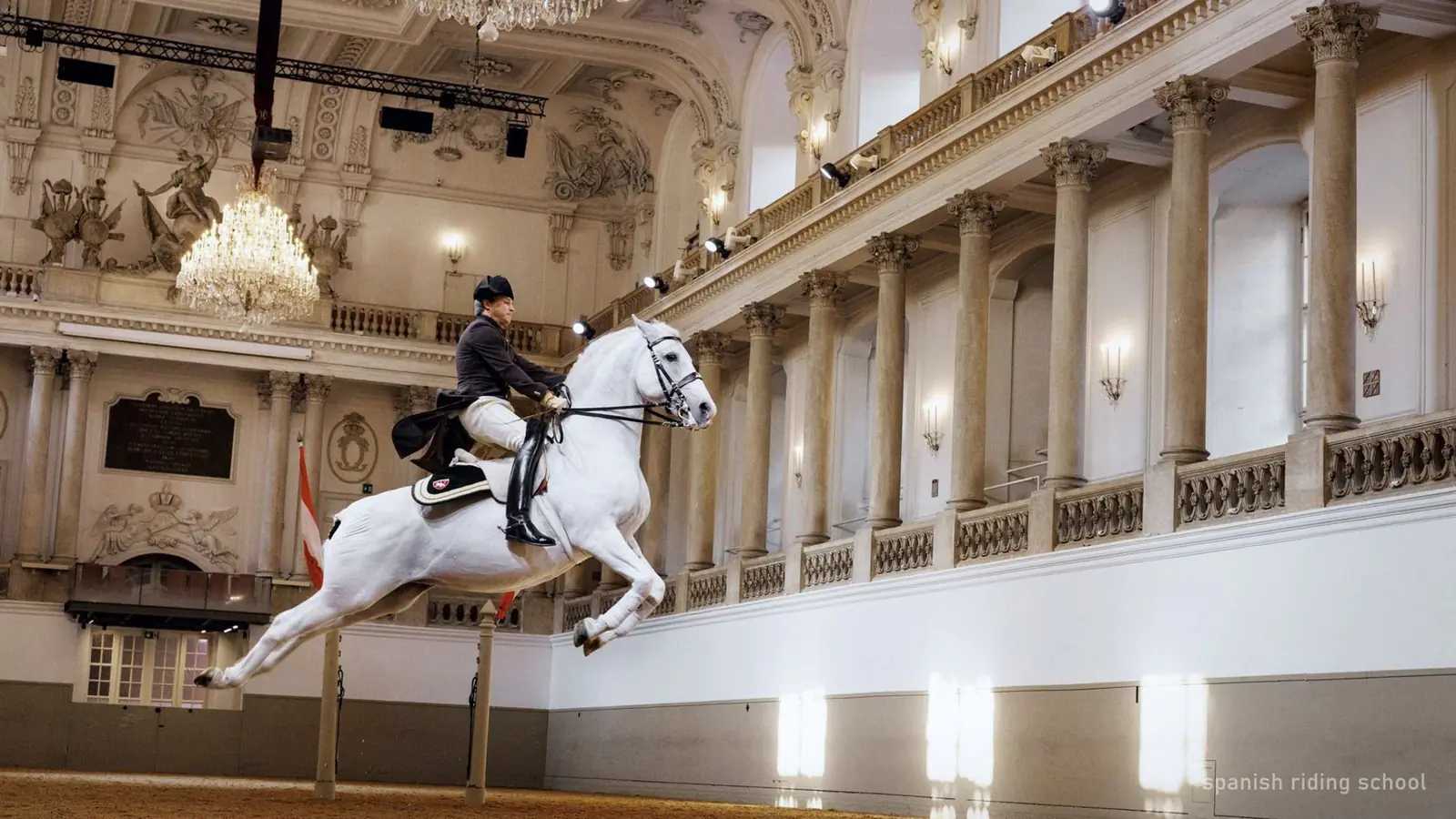
The Winter Riding School is the white hall where the performances happen: commissioned by Charles VI in 1729 from Joseph Emanuel Fischer von Erlach and finished in 1735, 55 metres by 18 and 17 metres high, galleried, chandeliered, and hung with Charles VI’s portrait above the royal box. Every rider salutes that portrait before riding. Our Winter Riding School page covers the building in detail.
The Stallburg, opposite on Reitschulgasse, is where the stallions are stabled — a Renaissance building of around 1558–1565, originally a residence for the future Maximilian II, and described as Vienna’s most significant Renaissance structure. You can see into its courtyard from the street for nothing.
Before 1735 the school worked out of a wooden arena at Josefsplatz; records show one commissioned as far back as 1565.
How a horse is trained
Three stages, and the timescale is the thing that surprises people.
Remontenschule, forward riding. A stallion arrives from the stud at Piber as a four-year-old and spends two to three months on the longe before a rider ever sits on him — transitions between walk, trot and canter, changes of tempo, building obedience and muscle. Then ridden on straight lines in an arena, on a long rein, learning to respond to the aids.
Campagneschule, the campaign school. The longest phase, generally two-thirds of the total training time, and usually several years. Collection, turns and circles at all gaits, lateral movements, shortening and lengthening the stride, and the development of impulsion and self-carriage. Young stallions are always placed with experienced riders here, to stop bad habits forming.
Hohe Schule, the high school. The most difficult movements — pirouette, passage, piaffe, one-tempi changes — pushed toward perfection in straightness, contact, suppleness and collection. Only at the end of this are the stallions assessed for whether they are suited to the airs above the ground, and each chosen horse is taught the school jump that suits him, first on the ground and then under saddle.
Not every horse gets there. That is the point of the assessment.
How a rider is trained
Longer than the horse, and the figures are worth stating because nothing else conveys what this institution is.
A rider works first on the longe, without stirrups or reins, on well-trained horses, for up to three years — purely to build a balanced, independent seat. Only then is he or she allowed to control the animals directly, under the eye of an experienced rider, until able to perform the high school movements. With intensive training that takes a further two to four years.
The rider is then allowed to train a young stallion from unbroken through to high school, a process that usually takes another four to six years.
Add it up and a fully formed rider at this school represents something like a decade of continuous training. It is a craft apprenticeship that happens to involve horses.
Traditionally the Lipizzaners were trained and ridden only by men, although the school states there was never an official ban on women. In October 2008 two women — Sojourner Morrell, then eighteen and from the United Kingdom, and Hannah Zeitlhofer, then twenty-one and Austrian — passed the entrance exam and were accepted to train as riders.
What happens in a performance
The programme has expanded over the years and runs in recognisable sections.
It opens with the Young Stallions, recently arrived from Piber, demonstrating the first phase of training — the horse moving forward and accepting the aids. Then All Steps and Movements of the High School, where four fully trained stallions in double bridle perform each of the movements found in the Olympic Grand Prix dressage test: flying change, passage, pirouette, piaffe. Then the Pas de Deux, two horses performing high school movements in mirror image.
The Work in Hand section shows how the school jumps are taught — levade, capriole and courbette — worked on the diagonal, along the wall and between the pillars. Those pillars are a recurring question from visitors: they are training apparatus, used to teach and collect the horse in hand. The stallions here wear snaffle bridles, cavessons and side reins, and all carry the school’s traditional white saddle.
Then one stallion is worked On the Long Rein, performing everything it would do under saddle, in a red snaffle bridle and a red shabrack carrying the golden coat of arms of the Austrian Empire.
The Airs Above the Ground follow: levade, capriole and courbette, all under saddle, with the riders working without stirrups.
It closes with the School Quadrille — eight riders in formation at walk, trot and canter, with flying changes, pirouettes, half pass and passage, to classical music. It lasts twenty minutes, and the school’s quadrille is the longest and most difficult in the world.
The three ways in
Four products, in fact, and they are genuinely different things at different prices. Read from the school’s own ticket page on 18 September 2026.
| What | From | Length |
|---|---|---|
| Performance | EUR 26 | About 45 or 70 minutes |
| Morning exercise | EUR 17 | About 60 minutes |
| Guided tour | EUR 24 | About 60 minutes |
| Architectural tour | EUR 26 | About 80 minutes |
The performance is the finished programme described above. The morning exercise is the stallions’ daily schooling watched from the gallery — the same hall, no choreography, nine euros less. The guided tour gets you into the Winter Riding School and the Stallburg whether or not any horse is working.
Which to pick is the decision most visitors get wrong, and our morning exercise versus performance page is built around it.
Reading the ratings before you book
The partner listings carry very different scores for the same institution, and the spread is instructive rather than alarming.
The performance rates 4.4 from 4,723 reviews. The guided tour rates 4.7 from 7,788. The architectural tour rates 4.8, though from only 343. The morning exercise rates 3.9 from 10,194 — the lowest figure on this site.
Reading the pattern rather than the number: the morning exercise is training, with no announcer, no order of events and no guarantee of anything spectacular, and a large share of the disappointed reviews come from people who booked the cheap ticket expecting the expensive product. Go knowing you are watching work and the 3.9 stops being a warning.
Summer, and the thing that ruins trips
All sixty-eight resident stallions go to the summer stables at Heldenberg in Lower Austria for seven weeks in July and August, where they are hacked in the forest rather than schooled.
In high summer there may be nothing in the hall at all. Check the school’s availability calendar before you build a day around the horses — the guided tour still runs, which makes it the fallback, and it is the best-rated product they sell.
Access, and one restriction worth knowing
The building is protected, so there is no lift. Wheelchair spaces at performances are limited and must be arranged with the school in advance, and the operator states plainly that the guided tours are not accessible by wheelchair.
The guided tour also does not admit children under three, and photography is not permitted on it. Our accessibility page covers the wider complex, and Hofburg Palace Tickets sets out how the school fits among the palace’s seven ticket operations.