
informational Pillar guide 9 min read
The Albertina in Vienna: What the Museum Holds
Updated September 18, 2026
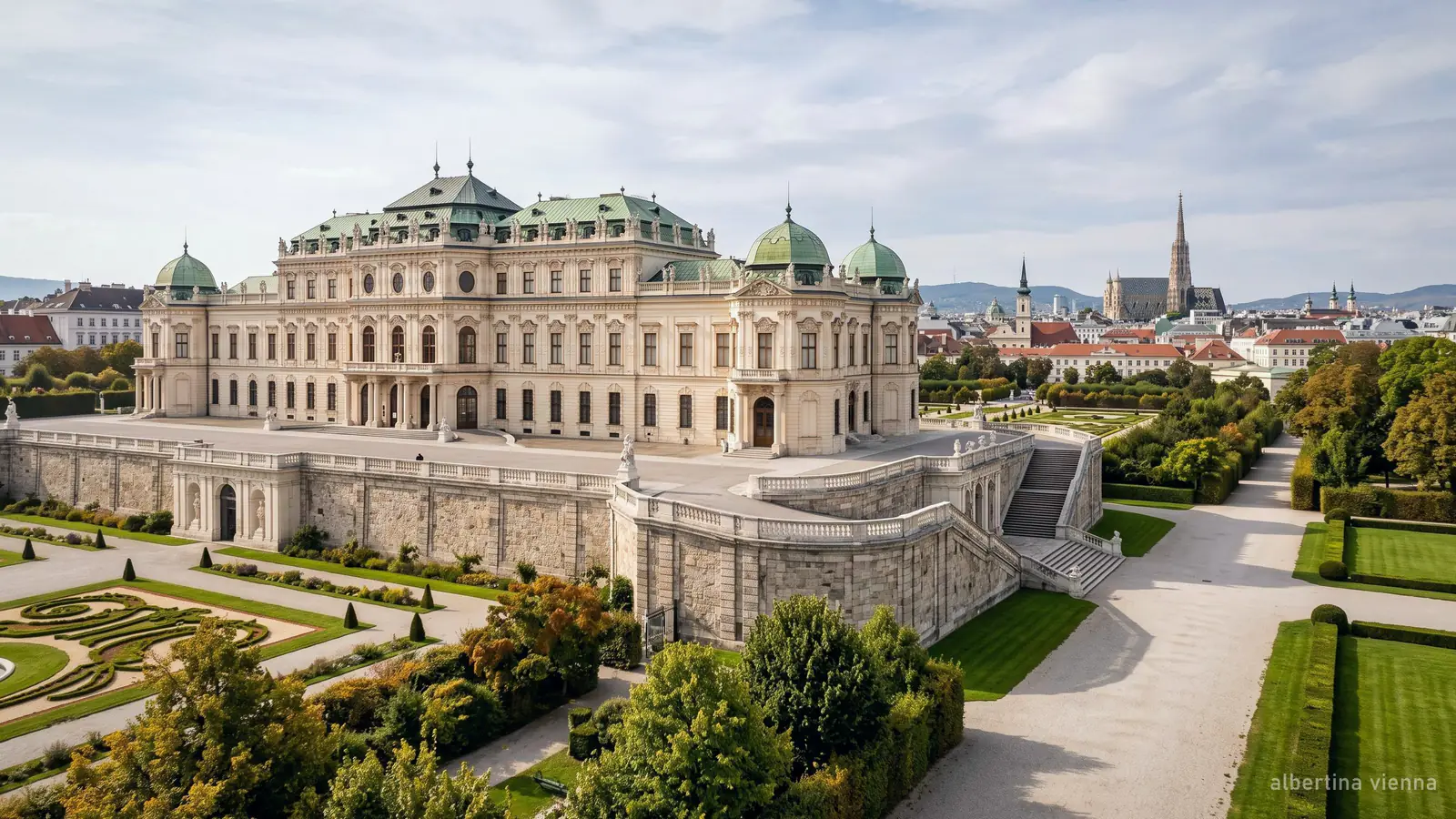
The Albertina in Vienna houses one of the largest and most important print rooms in the world: approximately 65,000 drawings and around one million old master prints, plus modern graphic work, photographs and architectural drawings. It occupies a Habsburg palace on the southern tip of the Hofburg, above the Burggarten, and it had 1,037,347 visitors in 2025.
It is part of the palace complex and it is nothing like the rest of it. Where the Imperial Apartments show you a family, this shows you what that family bought. For prices and opening hours, the tickets page has them; this page is about the collection and the building.
What the Albertina is famous for
Works on paper, at a scale almost nobody expects. The print room is the core of the institution and the reason it matters internationally: a million old master prints is not a collection, it is an archive of European printmaking.
On top of that it holds, on permanent loan, two significant collections of Impressionist and early twentieth-century art, some of it on permanent display. That is the part most visitors actually see, and it is why people arrive expecting a painting gallery and find a graphics museum with paintings attached.
The museum ranked 74th in the list of most-visited art museums in the world in 2025, with attendance down 3 per cent on 2024 but up 4 per cent on 2019, before the pandemic.
The palace it is in
The Albertina stands on one of the last surviving sections of Vienna’s fortifications — the Augustinian Bastion. That is why it is raised above the street, and why the terrace at the front looks out over the Burggarten and the opera the way it does.
The site originally held the Hofbauamt, the Court Construction Office, built in the second half of the seventeenth century. In 1744 the director of that office, Emanuel Teles Count Silva-Tarouca, refurbished it into his own palace, and it was known for a time as the Palais Taroucca.
It was then taken over by Albert Casimir, Duke of Teschen, who used it as his residence and brought his graphics collection there from Brussels, where he had been governor of the Habsburg Netherlands. He had the building extended by Louis Montoyer, and from that point the palace has bordered the Hofburg directly.
His successors kept expanding it. His grandson Archduke Albrecht lived there until his death in 1895, when it was called the Palais Erzherzog Albrecht. In the 1820s Archduke Charles — Albert and Maria Christina’s foster son — had Joseph Kornhäusel remodel much of the interior.
Who Albert and Maria Christina were
Worth knowing, because the museum carries his name and her tomb is two minutes away.
Albert Casimir, Duke of Teschen, built the collection together with the Genoese count Giacomo Durazzo, the Austrian ambassador in Venice and brother of the Doge of Genoa. In 1776 Durazzo presented nearly 1,000 pieces of art to Albert and his wife Maria Christina, who was Maria Theresa’s daughter. Durazzo’s stated ambition was to create a collection for posterity that served higher purposes than all others — education and the power of morality were to distinguish it.
Maria Christina died in 1798, and Antonio Canova sculpted her memorial: a marble pyramid with a procession of mourners walking into its open door. It stands in the Augustinian Church on Josefsplatz, inside the Hofburg, and it is free to go and look at.
So the two ends of this story are about eight minutes’ walk apart, and most visitors do one without knowing about the other.
How it became a public museum
In early 1919 the new socialist government of Austria confiscated both the building and the collection from Archduke Friedrich, without compensation, and evicted him. In 1920 the prints and drawings were united with the collection of the former imperial court library — the institution whose ceremonial hall is the State Hall on Josefsplatz. In 1921 the building was renamed the Albertina.
There is a harder chapter after that. During the Nazi era, and particularly after the Anschluss in 1938, artworks stolen from Jewish collectors made their way into the Albertina’s collection. After the war the museum resisted families’ requests that it restitute works by Gustav Klimt, Egon Schiele and others. In 2015 its director called for a moratorium on claims. Research continues, by both the families and the museum, to identify looted works.
That is not a footnote and we are not going to treat it as one. It is the same question the Weltmuseum’s feathered headdress raises on the other side of Heldenplatz, and a visitor is entitled to know it is open.
The Dürer problem
The single most common disappointment here, and it is entirely avoidable.
The Albertina’s most famous holdings are works on paper — Dürer’s Young Hare above all — and works on paper cannot be permanently displayed, because light destroys them. They spend most of their lives in storage and are shown periodically, in rotation and in dedicated exhibitions.
If a specific drawing is your reason for going, check the museum’s own programme before you buy a ticket. A high-quality facsimile is often shown in its place, and the museum labels it as one; people who did not check sometimes photograph the facsimile believing it is the original, and sometimes spend forty minutes hunting for something that is in a drawer.
Two minutes on the museum’s own site settles it.
What is reliably on show
The state rooms of the palace, which are part of the visit and connect this building to the rest of the Hofburg.
The modern collections on permanent loan — the Impressionist and early twentieth-century holdings — which are where the famous painted names sit.
And the temporary programme, which is the real reason to come and which changes several times a year. Two or three major shows usually run at once, and the crucial structural fact is that one admission covers all of them with no supplement. Our exhibitions page explains how the programme works and where to check it.
Albertina or Albertina Modern
Two museums, one name, about two kilometres apart, and the confusion is constant enough to be one of the most-searched things about the institution.
The Albertina is this building, at the Hofburg. Albertina Modern opened on 27 May 2020 in the Künstlerhaus on Karlsplatz and shows modern and contemporary work at EUR 17.90. There is no two-house ticket; the combo at EUR 29.90 covers all three Albertina locations, the third being Klosterneuburg, outside the city.
If someone recommends “the Albertina” without qualifying it, they mean this one. Our comparison page works through which suits which visitor.
How it fits a Hofburg day
Geographically it could not fit better: it is inside the palace complex, at the southern corner above the Burggarten, and you can reach it from the Imperial Apartments without crossing a road.
Practically, it is the end of the day rather than the middle. The Albertina is open daily 10:00 to 18:00 and until 21:00 on Wednesdays and Fridays, and those two late evenings are the quietest museum hours in central Vienna. A show with a queue at two in the afternoon is empty at eight.
The sequence that works: the palace route from 09:00, the Imperial Treasury before lunch, the Burggarten and the Palmenhaus in the afternoon, the Albertina from six. That is a full day inside the complex, and Hofburg Palace Tickets sets out what each leg of it costs.