
informational 6 min read
Photographs and Portraits of Empress Sisi
Updated September 18, 2026
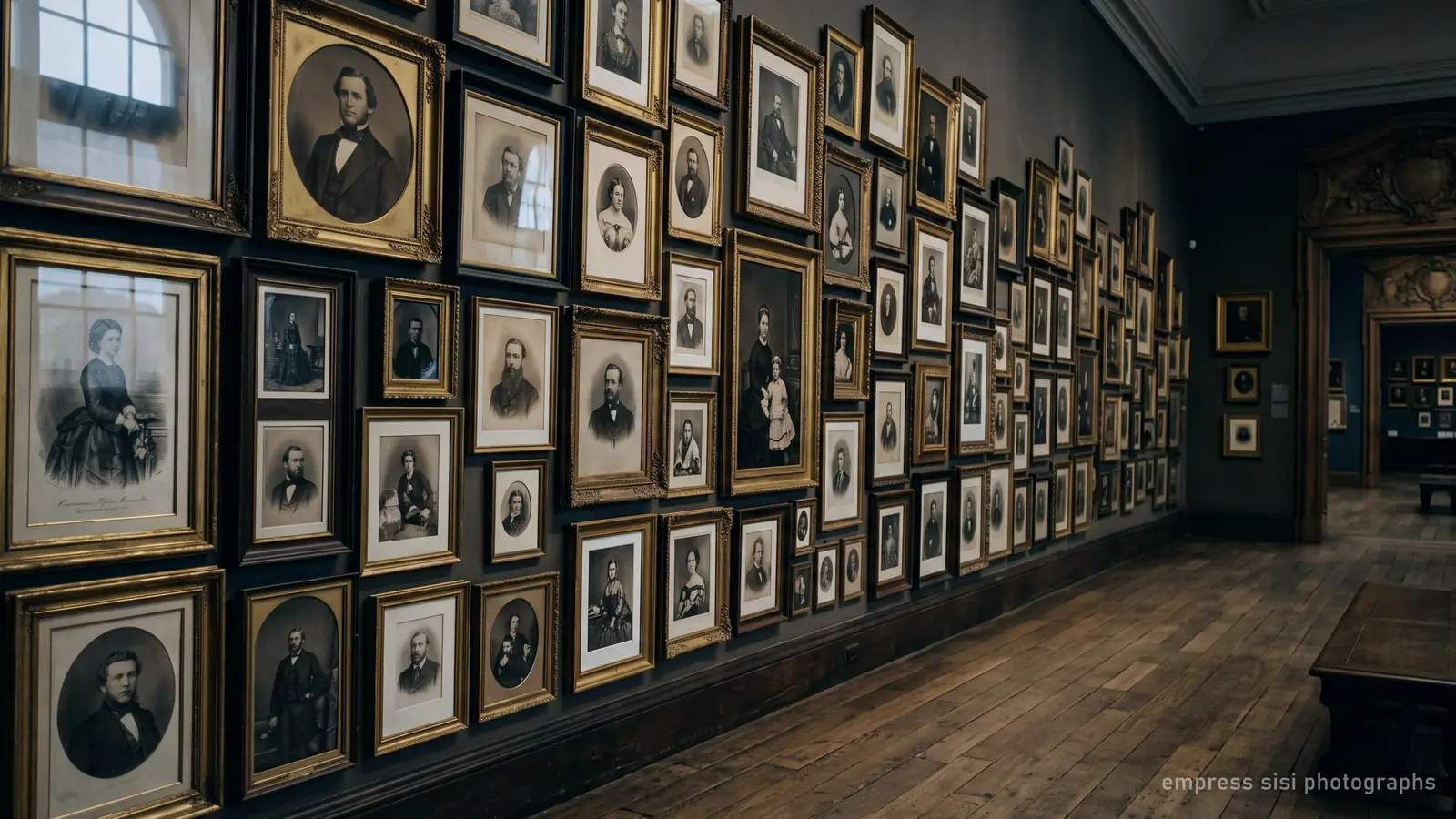
Almost every image of Empress Elisabeth in wide circulation shows a woman in her twenties or early thirties. She lived to sixty. The gap is not an accident of survival — she engineered it.
The photographs she permitted
Elisabeth developed an aversion to being photographed, and was quick with a fan or a sunshade to stop anyone taking her portrait. The sources record that this hardened as she got older; a very widely repeated claim puts the cut-off at the age of thirty-two, but the accounts we could check describe the aversion and its lateness without giving an age, so we are not going to give you one either.
What that means in practice is a body of authorised images concentrated in the 1850s and 1860s, when she was a young empress and photography was a court formality, and then a long silence.
The consequence is one of the most successful acts of image control in the nineteenth century. Elisabeth is fixed in the public mind at an age she spent two-thirds of her life past.
The last photograph question
This is the single most-searched thing about her pictures, and the honest answer is that it is disputed.
Several images circulate with the claim attached. Because she avoided the camera and was photographed without consent on occasion, candid and long-lens shots from her later years exist and are hard to date and authenticate. Attributions get repeated until they look settled and then get revised.
We are not going to name one and call it the last. What can be said with confidence is the shape of the thing: her late images are few, mostly unposed, often taken at a distance while she was walking, and usually show a veiled figure. That is the point — the veil is why they exist at all.
Winterhalter’s portraits
If the photographs are scarce, the paintings are not, and one painter made the image everybody knows.
Franz Xaver Winterhalter’s portraits of Elisabeth from the mid-1860s are the source of the standard picture of her: the full-length gown, the immense chestnut hair, and the diamond stars set in it. They are the most reproduced images of any Habsburg, and they are court portraiture doing its job — an idealisation, painted to be seen.
The famous version, with the stars in her hair, is the one every souvenir shop on the Kohlmarkt is selling. It was painted when she was in her late twenties.
The death mask
A death mask was taken after the assassination in Geneva in 1898, and it is the counterpart to everything above: the one image of her late face made with her full compliance, because she was dead.
The autopsy photograph of the wound was destroyed. Dr Golay photographed it and handed the picture to the Swiss Procurator-General, who had it destroyed on Franz Joseph’s orders, along with the autopsy instruments. That is worth knowing when you see how carefully the visual record around her end was controlled, from both directions.
Where to see them
The Sisi Museum, in her own apartments at the Hofburg, is the place the images and the objects are put together. It opened in 2004, was designed by Rolf Langenfass around her poetry, and its stated purpose is to set the documentary record against the popular one — which makes the gap between the Winterhalter portraits and the woman who weighed herself three times a day the museum’s central argument rather than an aside.
The Kunsthistorisches Museum and the Albertina hold nineteenth-century portrait and photographic material more broadly, and Elisabeth appears in both from time to time in temporary exhibitions rather than permanently.
The Imperial Crypt, five minutes away on the Neuer Markt, holds the grave. There is no image there, which after an hour of them is its own kind of information.
A practical note on taking your own
Photography is allowed at the Hofburg museums. The operator’s FAQ states that during opening hours filming and photography is generally permitted, but that tripods, selfie sticks and similar equipment are prohibited, as is flash and similar lighting. Given the subject, there is a certain symmetry in a museum about a woman who hated being photographed letting you photograph her rooms.