
informational 5 min read
Empress Sisi's Dresses and the Star Diamonds
Updated September 18, 2026
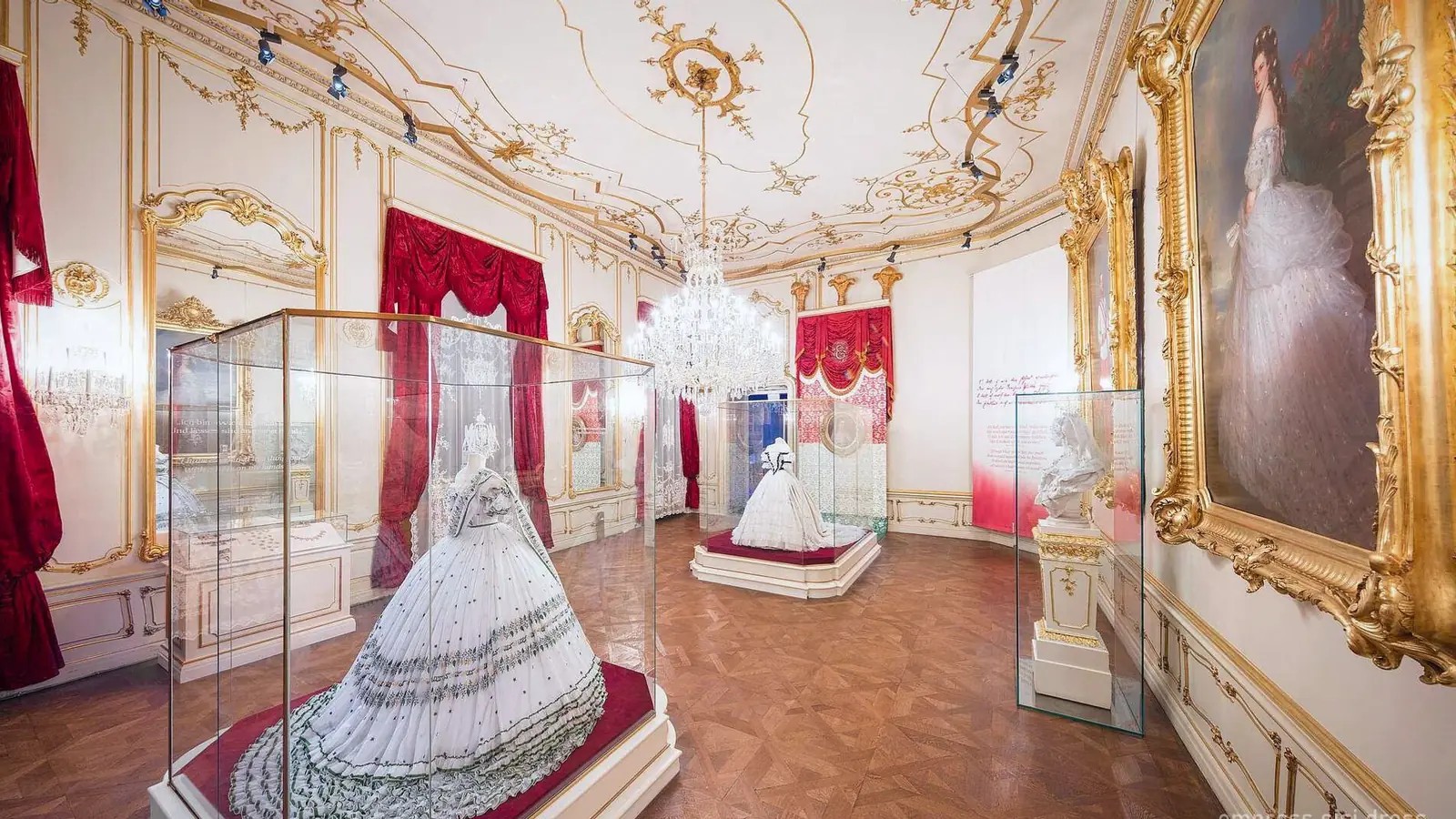
Her surviving clothing measures 47 to 49.5 centimetres at the waist — about nineteen inches. That is the figure that makes people stop in front of the cases, and it is the figure that explains most of what follows about how she dressed.
What she actually wore
Not what the films suggest. Elisabeth disliked expensive accoutrements and the court protocol that required constant changes of clothing, and she preferred simple, monochromatic attire cut like a riding habit.
She was at the front of abandoning the cage crinoline for a tighter, leaner silhouette when fashion began to move that way. She never wore petticoats or any other underlinen, because they added bulk. And she was often literally sewn into her clothes, to avoid waistbands, creases and wrinkles and to emphasise the wasp waist that became her signature.
The corsets underneath were not standard. Ordinary ones of the period fastened up the front with hooks and eyes; hers were made in Paris out of leather, more rigid and solid-fronted, because cloth would not take the strain. Lacing her in sometimes took nearly an hour.
The wedding dress
She married Franz Joseph on 24 April 1854 in the Augustinerkirche — the church inside the Hofburg complex, on Josefsplatz, a two-minute walk from the museum. She was sixteen.
The dress from that day is among the garments the Sisi Museum addresses. Like most of her clothing it did not survive intact, which is the recurring problem with this material and the reason the museum works the way it does.
The star diamonds
The single most recognisable object associated with her, and the thing every souvenir shop on the Kohlmarkt is selling in some form.
They are diamond stars, worn set into her hair, and they appear in Franz Xaver Winterhalter’s portraits of the mid-1860s — the paintings that fixed the public image of her. Because those portraits are the image, the stars have become a kind of logo: they are on the museum’s own material, on the packaging of Vienna’s chocolate, and on the tourist merchandise of an entire city.
The originals were dispersed. Elisabeth’s will directed that a large part of her jewellery be sold, with the proceeds — then estimated at over £600,000 — going to religious and charitable organisations.
Why so few originals survive
Three reasons compound.
Textiles are fragile, and nineteenth-century dyes and silks in particular do not last. Her wardrobe was dispersed rather than curated — nobody in 1898 was assembling a museum. And her clothes were worked hard: sewn into, unpicked, altered, laced to destruction.
What the Sisi Museum shows is therefore a mixture. Some original garments and accessories, and some careful reconstructions, and the museum labels which is which. A reconstruction is not a disappointment if you understand what you are looking at: the measurements are taken from the surviving originals, so the reconstruction tells you the true thing — the size of her — even when the fabric is new.
The dress she was wearing in Geneva
On 10 September 1898 she was walking along the lakeside in Geneva when Luigi Lucheni drove a sharpened needle file into her chest. Countess Sztáray opened her dress and cut the corset laces so she could breathe.
The corset is part of the medical story rather than the fashion one. The autopsy found that the tight lacing had slowed the bleeding into the sac around her heart to a few drops at a time, which is why she was able to walk a hundred yards and board the steamer after being stabbed through the heart. The thing that had constrained her for forty years kept her alive for half an hour.
Where to see them
The Sisi Museum, in her own apartments in the Hofburg, on the standard palace day ticket at EUR 20 for an adult. The clothing is shown alongside the gymnastic equipment from her exercise room, which is in the Imperial Apartments on the same route — and seeing the two in sequence is the point the museum is making.