
informational Pillar guide 10 min read
The Imperial Crown of the Holy Roman Empire
Updated September 18, 2026
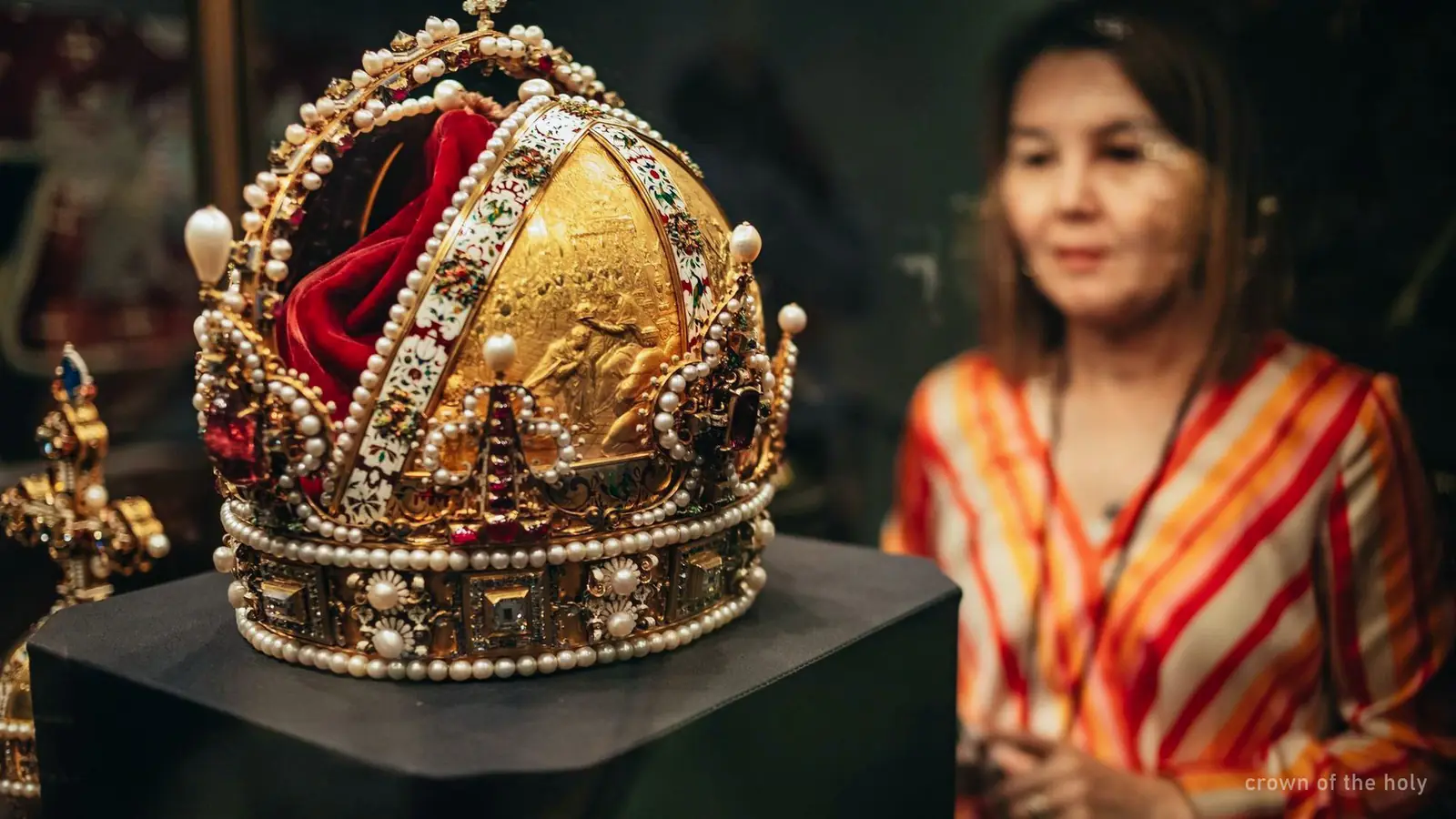
The Imperial Crown of the Holy Roman Empire is in Vienna, in the Imperial Treasury at the Hofburg, and an adult can stand in front of it for EUR 16 booked online. It is an octagonal hoop crown of 22-carat gold set with 144 precious stones and about as many pearls, it crowned emperors for something between eight and nine centuries, and almost everything about its date is argued over.
This page is about the object. If you want the room it sits in and how to get into it, the Imperial Treasury guide covers that, and Hofburg Palace Tickets sets out how the palace’s seven separate ticket operations fit together.
What the Imperial Crown is
A Bügelkrone — a hoop crown — with a characteristic octagonal shape rather than a round one. It was the coronation crown of the Holy Roman Emperor, probably from the late tenth century until Napoleon brought the empire to an end in 1806, and it was used at the coronation of the King of the Romans, the title an emperor-elect took immediately on election.
The octagon is not decorative. It is generally read as a reference to the crowns of Byzantine emperors, or to the shape of Charlemagne’s Palatine Chapel at Aachen, or to both — a claim of succession built into the geometry.
Eight hinged golden plates, arched at the top, held together by two riveted iron strips of unidentified date. Before those strips were added, long golden pins held the plates together, which meant the whole crown and its arch could be taken apart for transport. That detail tells you most of what you need to know about its early life: this was an object that moved.
Who owns it
The Republic of Austria. The crown is part of the collection of the Imperial Treasury, which is administered by the Kunsthistorisches Museum, and it has been in Vienna permanently since January 1946.
That answer regularly surprises people, because the crown is German rather than Austrian in origin and Germany has asked about it more than once. The short version of how it ended up here is in the next two sections, and it involves a revolution, a dissolution and a war.
How old is it, and why nobody can agree
The standard dating puts the crown in the second half of the tenth century, made in western Germany for the imperial coronation of Otto I in 962, with later additions — the arch is inscribed with the name CHVONRADUS, which points to Conrad II.
That standard dating is not settled. The historian John B. Freed notes that the inscriptions on the plaques have been dated on palaeographic grounds to no earlier than the second half of the eleventh century, and that the biblical verses on three of the four picture-plates were first cited in royal charters only in the late eleventh and twelfth centuries. He proposes instead that the crown was made for the imperial coronation of Conrad III in Rome — a coronation that never happened.
Freed’s supporting argument is unusually specific. The imperial title on the crown matches how Conrad styled himself in a letter he sent to the Byzantine emperor John II Komnenos in 1142. And the odd choice of text from Isaiah on the Hezekiah plaque — a promise of fifteen more years of life — makes most sense, he argues, if Conrad commissioned it, since he fell seriously ill during the Second Crusade with tertian malaria and was unable to carry out his duties from August 1149 to April 1150.
Others read it differently. Reinhard Staats takes the Isaiah text as a general memento mori for any monarch. Denise A. Kaiser argues that Otto II commissioned the crown and that the Hezekiah plaque refers to Otto I’s recovery from a serious illness.
The earliest secure mention of the crown is from the twelfth century, assuming — as is probable — that it is the same crown. That is the honest state of the question: somewhere between the 960s and the 1140s, with good arguments at both ends.
The design, plate by plate
Each of the eight plates is high-carat gold, around 22 carats, which gives the crown its unmistakable buttery colour rather than the hard yellow of modern gold.
The stones are not cut into facets — faceting was still unknown when the crown was made. They are polished into rounded shapes and set en cabochon, dropped into openings cut through the metal and fastened with thin wires. The effect, when light gets behind them, is that the stones appear to shine from within. There are 144 of them, including sapphires, emeralds and amethysts, and roughly the same number of pearls. Blue, green and purple were the colours proper to emperors under Byzantine imperial protocol.
Four of the plates are Bildplatten, picture-plates, carrying figures and scenes from the Bible in cloisonné enamel in the Byzantine “sunk” Senkschmelz style, each framed by blue sapphires and pearls in raised filigree.
| Plate | What it shows | The inscription |
|---|---|---|
| Front right | Christ in Majesty between two cherubim | “By me kings reign” (Proverbs 8:15) |
| Back right | Isaiah speaking to King Hezekiah, sitting on his bed | “Behold, I will add fifteen years to your life” (II Kings 20:6) |
| Front left | King Solomon holding a scroll | “Fear the Lord and flee from evil” (Proverbs 3:7) |
| Back left | King David holding a scroll | “The renowned king delights in doing justice” (Psalm 99:4) |
The other four are Steinplatten, stone-plates, of various sizes and decorated with precious stones and pearls alone. The twelve stones on the front and back plates are probably a deliberate reference to the twelve stones of the Jewish high priest’s breastplate and to the twelve foundation stones of the New Jerusalem in Revelation.
The single arch running front to back carries, in seed pearls, the name and imperial style that probably belonged to Conrad II — the first German monarch to call himself king of the Romans. The left side reads “Conrad, by the Grace of God”; the right, “Emperor of the Romans, Augustus”. In front of the arch sits a jewelled cross with the crucified Christ engraved on its reverse, originally a pectoral cross said to have belonged to Henry II and only later attached to the crown.
Two more details worth looking for. There are three small holes in each of the side stone-plates, which probably once held chains of pendant jewels — pendilia, a Byzantine imperial feature that survives on the Holy Crown of Hungary. And the red velvet cap inside dates only from the seventeenth century; before that the crown was worn over a mitre.
The stone that is missing
The top central stone of the front plate is a triangular sapphire, and it is a replacement.
What it replaced was the Waise — the Orphan, so called because nothing like it had been seen anywhere else. It was probably a large white opal with a wine-red fire, or possibly a singularly brilliant garnet or red zircon, and it generated a body of medieval lore on its own. Albert the Great described it in 1250:
“The Orphan is a jewel in the crown of the Roman emperor. Because the like of it has never been seen elsewhere, it is called the ‘Orphan’. It has the color of wine, of delicate red wine and it is as if the dazzling, white of snow penetrates the bright wine red and yet it remains dormant in this redness. The gem shines powerfully and it is said that it once even shone at night, but not in our time, but it is said to preserve the honour of the empire.”
Nobody knows when or why it was removed. The last mention of it is in an inventory ordered by Charles IV in 1350.
If you look at only one thing on the crown, make it the empty-looking triangular stone at the top of the front plate, and know that something better used to be there.
Where the crown has been
The itinerary is the reason the crown could be dismantled, and it is a compressed history of central Europe.
In its first centuries it was held at Limburg Abbey, Harzburg Castle, the imperial palaces of Goslar and Haguenau, Trifels, Waldburg, Krautheim, Kyburg, Rheinfelden and the Alter Hof in Munich.
In 1349 Charles IV took the imperial regalia to Karlstein Castle near Prague, which he had built for the purpose. In 1424, with Bohemia in the middle of the Hussite Wars, Sigismund moved them to Visegrád and then to Nuremberg, where they were kept permanently in the Heilig-Geist-Spital except during coronations — at Aachen until 1531, then at Frankfurt from 1562.
In 1796, with revolutionary France threatening the whole fabric of the empire, the regalia went to Saint Emmeram’s Abbey in Regensburg, and from there in 1800 to Vienna. The empire itself was abolished on 6 August 1806, six years after its crown reached the city where it still is.
1938, and the men who brought it back
The crown and the rest of the regalia stayed in Vienna until the Anschluss in March 1938, when Nazi Germany took them back to Nuremberg — to the Katharinenkirche this time — as part of its promotion of that city as the repository of a mythologised German past.
During the war the crown was placed in the Historischer Kunstbunker, an underground vault beneath Nuremberg Castle. American soldiers recovered the treasures there in August 1945, in an operation led by the art historian Lieutenant Walter Horn, a German émigré who had become a naturalised US citizen and joined the US military.
They were returned to the Österreichische Nationalbank in allied-occupied Austria in January 1946 and have been in Vienna ever since. The crown went back on display at the Hofburg in 1954, and the arrangement you see today dates from a comprehensive refurbishment of the Treasury vault between 1983 and 1987.
The copies
If you have seen the crown somewhere else, you have probably seen a copy, and there are several good ones.
An identical copy was made in 1915 on the order of Wilhelm II for display at Aachen, where it is still kept in the Krönungssaal of the town hall — a fourteenth-century building standing on the remains of Charlemagne’s palace. There are further copies in the Historical Museum of Frankfurt, at the fortress of Trifels in the former Electorate of the Palatinate, and at Karlštejn in Czechia, alongside a copy of the Crown of Saint Wenceslas.
Seeing the real one
The Imperial Treasury is in the Schweizerhof, the oldest courtyard of the Hofburg, reached through the red-and-black Swiss Gate. It is run by the Kunsthistorisches Museum rather than by the palace’s own operator, so it is a separate ticket and a separate door from the Imperial Apartments.
| Ticket | Online | At the door |
|---|---|---|
| Adult | EUR 16 | EUR 18 |
| Reduced | EUR 12 | EUR 14 |
| Under 19 | Free | Free |
Open daily except Tuesday, 09:00 to 17:30, with admission until 30 minutes before closing — so the real cut-off is 17:00. Closed 16 to 27 February 2026 for annual maintenance. Read from the Treasury’s own entrance fees page on 18 September 2026.
Allow an hour for the Treasury as a whole and ten minutes of it for the crown. It sits in the secular half, with the coronation vestments, the treasure of the Order of the Golden Fleece, and the Holy Lance — a Carolingian spearhead with a comparable weight of legend attached and a comparable gap between the legend and the laboratory results.
The Tuesday closure is the single most common way a visit here goes wrong. Check the day before you plan anything else around it.