
informational 7 min read
The Holy Lance in the Imperial Treasury
Updated September 18, 2026
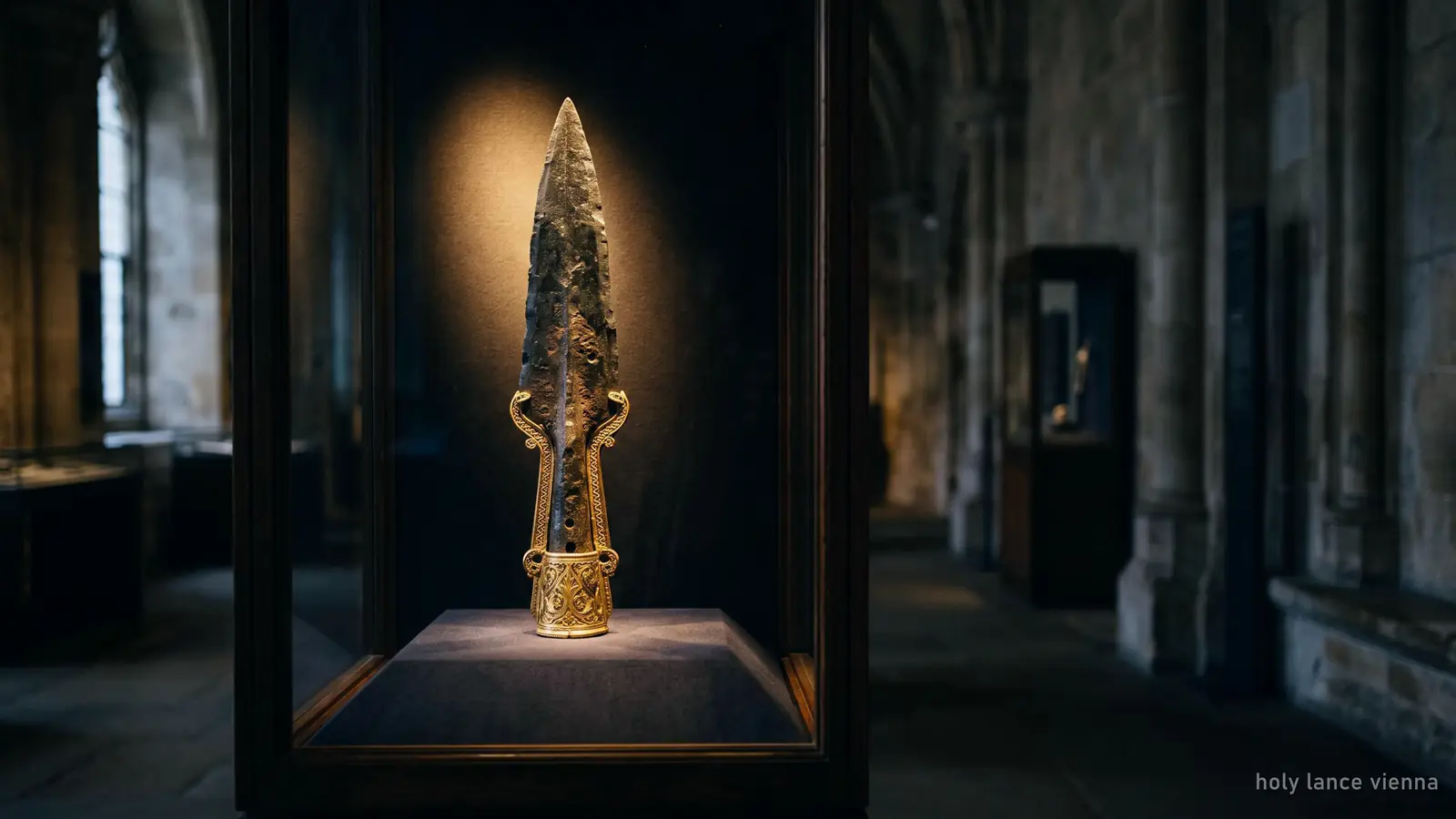
Yes — the object usually called the Spear of Destiny is in the Hofburg, in the secular half of the Imperial Treasury, a few metres from the Imperial Crown. It is a Carolingian winged lance head wrapped in a gold cuff, and it is one of the most looked-at objects in Vienna. It is also, on the evidence of three separate scientific examinations, several centuries too young to have been at the Crucifixion.
Both of those things are true at once, and the room does not hide either.
What the object actually is
The head of a typical winged lance of the Carolingian period. The shaft had already been lost or destroyed by the reign of Conrad II (1024–1039), who commissioned the Reichskreuz — the Imperial Cross — to serve as a reliquary for the spearhead itself.
Two metal cuffs hold it together, and each one is a historical document. The outer gold cuff was added by Charles IV around 1354 and carries the Latin inscription LANCEA ET CLAVVS DOMINI — “the lance and nail of the Lord” — asserting both that the lance was Longinus’s and that one of the Holy Nails has been worked into the blade. Underneath it sits an older silver cuff made for Henry IV between 1084 and 1105, which also mentions the Holy Nail but calls the spearhead something else entirely: the lance of Saint Maurice.
That change of identity is the most interesting thing about the object. The spearhead was renamed at least once by the people who owned it.
How the Habsburgs came to have it
Liutprand of Cremona records that the first German monarch to obtain the lance was King Henry the Fowler, who bought it in 926 from King Rudolf II of Burgundy. On 15 March 933 Henry carried it against the Magyars at the Battle of Riade. From that point the Ottonian dynasty treated the lance as a talisman that guaranteed victory, and the choice of 15 March — the feast day of Longinus — suggests Henry already associated it with the Crucifixion.
By 1008 it was being identified with Saint Maurice instead, probably because closer diplomatic contact with Byzantium had made the Longinus claim awkward: Constantinople had a Holy Lance of its own.
Otto III had two replicas made. One went to Prince Vajk of Hungary in 996, the future King Stephen I; the other to Duke Bolesław I of Poland at the Congress of Gniezno in 1000. The Polish replica is in the John Paul II Cathedral Museum in Kraków today.
In 1424 Sigismund moved the imperial relics from Prague to Nuremberg and decreed that they be kept there forever. Forever lasted until 1796, when the French Revolutionary army approached and the Nuremberg authorities handed the regalia to an imperial commissary, who moved them to Regensburg, then Passau, Linz and Vienna, then Hungary, then back to Vienna. When Nuremberg later asked for them back, Austria said no.
What the tests found
Three examinations, three answers, all pointing the same way:
| Examination | Date given |
|---|---|
| Kunsthistorisches Museum | 8th century |
| Robert Feather, metallurgist, 2003 | 7th century at the earliest |
| Interdisciplinary Research Institute for Archeology, Vienna | 8th to early 9th century |
The Vienna institute used X-ray and other non-invasive methods, found that the iron pin in the blade appears to be the same metal as the lance itself, and ruled out a 1st-century AD date.
Feather’s tests, done for a documentary, reached the earliest date of the three and added one nuance worth keeping: he judged the pin — long claimed to be a nail from the Crucifixion, set off in the blade by tiny brass crosses — to be “consistent” in length and shape with a 1st-century Roman nail. Consistent is not the same as identified, and he still dated the body of the spear to the 7th century at the earliest.
So the honest summary is this: the lance is a genuine early-medieval imperial relic with an extraordinary documented history, and it is not the weapon described in the Gospel of John.
Why the name Spear of Destiny stuck
Not from the Treasury, and not from the Church. The Hofburg spear has been reimagined in popular culture as a magical talisman whose powers can be used for good or for evil, and the phrase travels with that version of it — through Wolfenstein 3D’s Spear of Destiny prequel, through the Indiana Jones comics and Dial of Destiny, and through a long tail of occult literature.
If you search for “Spear of Destiny Hofburg” you are searching for a pop-culture name for a real object that the museum labels differently. Ask a guard for the Heilige Lanze and you will be pointed at the same case.
Where to find it
Imperial Treasury, in the Schweizerhof — the oldest courtyard of the Hofburg, reached from the Swiss Court gateway. The lance is displayed with the rest of the imperial regalia, which means you see it in the same sequence as the Imperial Crown, the Imperial Cross that was made to hold it, and the coronation vestments.
Read from the Treasury’s own ticket page on 18 September 2026:
| Ticket | Online | At the door |
|---|---|---|
| Adult | EUR 16 | EUR 18 |
| Reduced | EUR 12 | EUR 14 |
| Under 19 | Free | Free |
The Treasury is open daily except Tuesday, 09:00 to 17:30, with admission until 30 minutes before closing, and it closes for annual maintenance from 16 to 27 February 2026.
One practical note: the Treasury is a separate ticket from the Imperial Apartments and the Sisi Museum. A palace day ticket does not get you into this room.