
informational 8 min read
The Imperial Silver Collection at the Hofburg
Updated September 18, 2026
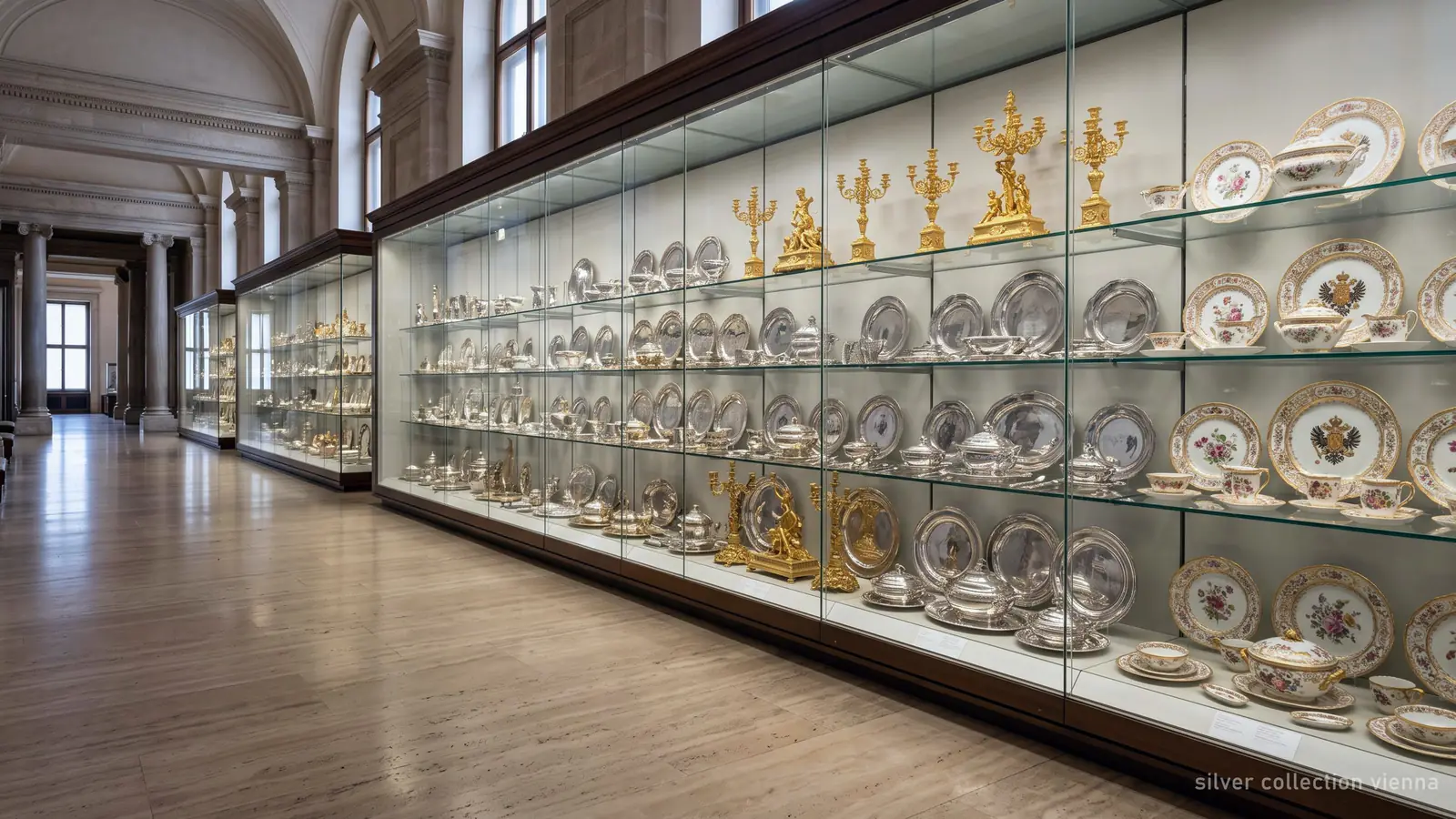
The Imperial Silver Collection is the first thing on the palace museum route and the one almost everybody walks through on their way to Sisi. It cares for around 135,000 objects associated with dining at the imperial court, it is included in the EUR 20 day ticket whether you look at it or not, and it is the only part of the complex that shows how the household actually functioned day to day.
Give it twenty minutes rather than five. This page says what to give them to.
What the Imperial Silver Collection is
Not a treasury and not a museum of precious metal. It is the surviving working stock of the court’s dining departments — the things that were carried, laid, filled, washed and put away, thousands of times, by people whose job that was.
When the monarchy ended in 1918, the holdings of the various court household departments that serviced the imperial table passed to the Republic of Austria. A part of that inheritance is what is on show. The rest is still in store, which is why the collection is described in tens of thousands of objects rather than by a gallery count.
That provenance is the thing that makes the room interesting. Most palace museums show you what a court owned. This one shows you what it used.
Why a household needed 135,000 objects
Because an imperial table was a logistical operation, not a dinner.
A state banquet required a complete service laid identically for every guest, replaced between courses, at a scale that meant holding many multiples of everything. Add the different services for different occasions, ranks and residences — the court moved between the Hofburg and Schönbrunn and elsewhere — and the arithmetic stops being surprising.
The collection is effectively the inventory of that system: the plates and the platters, but also the warming equipment, the serving pieces, the specialised implements for foods that no longer require specialised implements.
The porcelain
Beyond the silver itself, the operator names porcelain among the collection’s real strengths, and it is the part most visitors underrate.
Two things sit side by side. The Habsburgs’ important collection of eighteenth-century East Asian porcelain, acquired when such pieces arrived in Europe as luxury imports and were valued accordingly. And work from the Vienna Porcelain Manufactory, the state manufactory founded in the city in the eighteenth century, which is the domestic answer to those imports.
Seeing the two in one room is a compressed history of European taste: first you buy it from China, then you work out how to make it yourself.
The centrepieces and the glass
The other two strengths the operator names.
The monumental gilt-bronze centrepieces are the objects that stop people. They are not tableware in any ordinary sense — they are architecture for a table, designed to run down its length and be seen from both sides, and they were the visual event of a banquet before anyone sat down.
The fine drinking glass services are the quieter half and the more fragile. Glass used at imperial banquets survives in far smaller quantities than metal, for obvious reasons, and what is here is a rare sample of what a court actually drank out of.
The imperial napkin
One object in the collection is not displayed so much as performed.
The imperial napkin is still folded today, in keeping with the court tradition, by the collection’s own housekeepers — the technique kept alive by the people who look after the cupboards rather than by a conservation department or a curator.
It is a small thing and it is the single detail that makes the room legible. A cupboard of tableware is inert. A cupboard of tableware with one fold in it that somebody has to know how to do, and does, is a living institution that outlived the empire it was built for by more than a century.
If you look at one thing here, look at the napkin.
It is not the Imperial Treasury
This confusion is common enough that the operator answers it in its own FAQ. Asked whether the Silver Collection is the same thing as the Imperial Treasury, it replies: “No. The Imperial Treasury Vienna is also in the Hofburg (in the Swiss Court), but houses the regalia of the Holy Roman Empire and the Austrian Empire.”
So, plainly:
| Silver Collection | Imperial Treasury | |
|---|---|---|
| What | Court tableware and dining objects | Crowns, regalia, the Holy Lance |
| Where | On the palace route, off In der Burg | The Schweizerhof, through the Swiss Gate |
| Operator | Schloss Schönbrunn group | Kunsthistorisches Museum |
| Ticket | Included in the EUR 20 day ticket | Separate: EUR 16 online, EUR 18 at the door |
Tableware here, crown jewels four minutes’ walk away. Our Imperial Treasury guide covers the other one, and the Imperial Crown page covers the object most people came to Vienna for without realising it needs a second ticket.
Is it included in the Hofburg ticket?
Yes. The EUR 20 adult day ticket covers the Silver Collection, the Sisi Museum and the Imperial Apartments as a single one-way route, with a free audio guide in fourteen languages. A child aged 6 to 18 pays EUR 12 and a student aged 19 to 25 pays EUR 18.
You could not skip it if you wanted to: it comes first, and the route runs one way. Our ticket page lists every category, and the operator publishes them on its own tickets and prices page.
How long to give it
Twenty to forty minutes, out of a two-hour route.
The mistake nearly everyone makes is pace. Visitors arrive at 09:00 keen, spend eight minutes here because it is “just plates”, and then run out of attention two-thirds of the way through the Sisi Museum. The better distribution is thirty minutes here, forty in the Sisi Museum and fifty in the apartments — our how long page breaks the route down.
If you are genuinely short of time, ten focused minutes on the centrepieces, the East Asian porcelain and the napkin will do more than twenty-five minutes of walking past cabinets.
Why it is better than it sounds
Because it is the only room at the Hofburg about work.
The Imperial Apartments are about a marriage, the Sisi Museum is about a reputation, the Treasury is about legitimacy. This is about the several hundred people it took to put dinner on a table, and it is the only place in the complex where the staff are the subject.
That is also why it pairs well with the rest of the site. The Imperial Apartments show you the rooms these objects were carried into, and Hofburg Palace Tickets sets out how the whole complex divides up.