
informational 6 min read
The Redoutensäle and the Festsaal at the Hofburg
Updated September 18, 2026
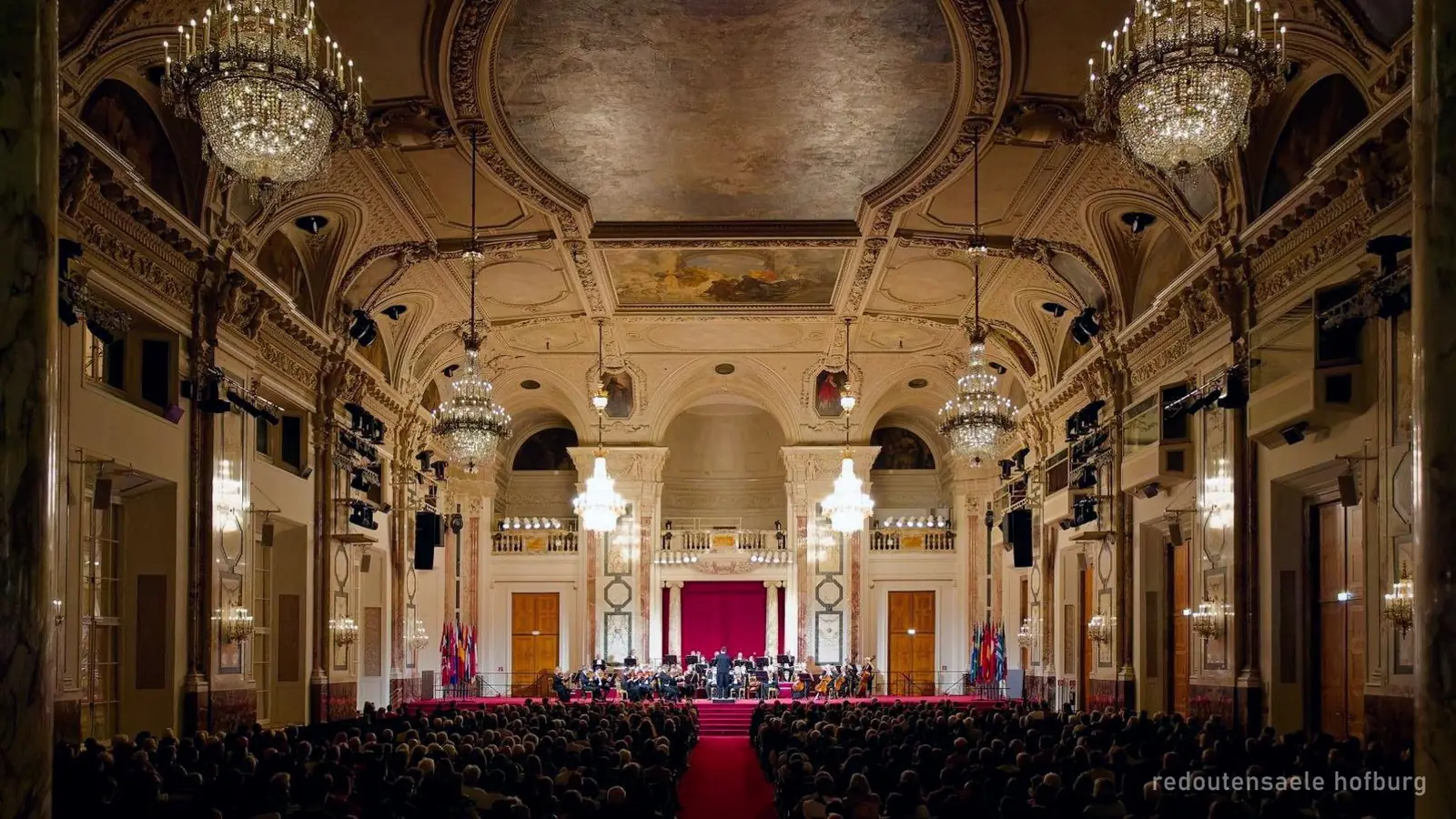
The Redoutensäle are the Hofburg’s ballrooms, on the Josefsplatz side of the palace, and they are the rooms behind almost every evening event you can buy a ticket to here. They are also the only significant part of the palace that is not old — the larger of the two burned down in 1992 and what stands today is a deliberate modern interior inside a historic shell.
What they were built for
Redoute is a masked ball, and that is what the rooms were for: court entertainments, at a scale the residential wings could not host. There are two, the Grosser Redoutensaal and the Kleiner Redoutensaal, and they sit alongside the Festsaal, the Zeremoniensaal, the Rittersaal and the Marmorsaal in the palace’s ceremonial suite.
This is where the Habsburg court did the part of its job that involved being seen. The same rooms now host the Vienna ball season, which is the same activity with a different guest list.
The fire
During the night of 26–27 November 1992 a large fire started in the Hofburg in the area of the Redoutensäle on Josefsplatz. Part of the roof and the upper floor burned completely.
The Great Redoutensaal was destroyed. Its stucco ceiling of 1892 came down and the baroque roof timbers went with it. The Spanish Riding School and the Austrian National Library were both threatened — the State Hall and its 200,000 books are metres away, and the Lipizzaner stallions are stabled in the Stallburg on the other side of Josefsplatz — and both were saved.
It was the third major fire in the palace’s documented history, after 1668, during which Emperor Leopold I had to be rescued, and 1848, when fire during the Vienna Rebellion burned part of the imperial library.
What was built back
The restoration was finished by 1997, and the decision taken for the Great Redoutensaal is the interesting part.
The Small Redoutensaal was restored to its historic form. For the Great Redoutensaal, the choice was not to fake what had been lost. The painter Josef Mikl was commissioned to design a new interior, and the wall and ceiling paintings in the room today are his — oil paintings based on texts by Ferdinand Raimund, Johann Nepomuk Nestroy, Elias Canetti and Karl Kraus.
So the largest ballroom in the Hofburg has a late-twentieth-century ceiling built on Austrian literature, in a palace otherwise devoted to pretending the nineteenth century never ended. Whether it works is a matter of taste and Vienna has not entirely made up its mind, but it is honest in a way a reconstructed stucco ceiling would not have been.
Two notes on attribution, since this gets muddled online. The artist is Josef Mikl, not Christian Ludwig Attersee — the two are often confused in accounts of the rebuild. And the ceiling that burned dated from 1892, not from the baroque period; the roof timbers were the old part.
What happens in them now
They are run as a conference and events venue, the Hofburg Vienna congress centre, which operates the Festsaal, the Zeremoniensaal, the Rittersaal, the Marmorsaal, both Redoutensäle and a set of smaller rooms including the Geheime Ratstube and apartments named after Radetzky, Maria Theresa and Metternich.
Three kinds of thing happen there: congresses and corporate events, which is the commercial core; the ball season, which runs from roughly January to March and is the reason Vienna’s formalwear hire shops exist; and concerts, including the Vienna Hofburg Orchestra’s Mozart and Strauss programme.
This is also why parts of the palace close without warning. If a congress has taken the Festsaal, that wing is not available, and the museum route is unaffected but the event rooms are shut.
How to get inside
There is no museum ticket for these rooms. Three routes in:
A concert. The Vienna Hofburg Orchestra plays a 90-minute Mozart and Strauss programme with up to forty musicians, opera singers and ballet dancers, from EUR 90 per person. Check the venue when booking — the orchestra also plays at the Konzerthaus, and the listing states that the meeting point varies with the option booked.
A ball. Expensive, formal, and the dress code is enforced at the door: usually white tie for men and a full-length gown for women, though it varies by ball.
A congress. Not a route most visitors can take, but it explains why the rooms sometimes appear on social media without a concert attached.
If none of those fit, the compensation is that Josefsplatz outside — the square these rooms open onto — is free, open and the most complete baroque square in Vienna.