
informational 6 min read
Concerts and Balls at the Hofburg
Updated September 18, 2026
The Hofburg has two lives. In daylight it is a museum complex that closes at half past five. After dark the same building is a concert hall, a ballroom and one of Europe’s busier conference venues, and almost none of that appears on a visitor’s itinerary.
The concerts
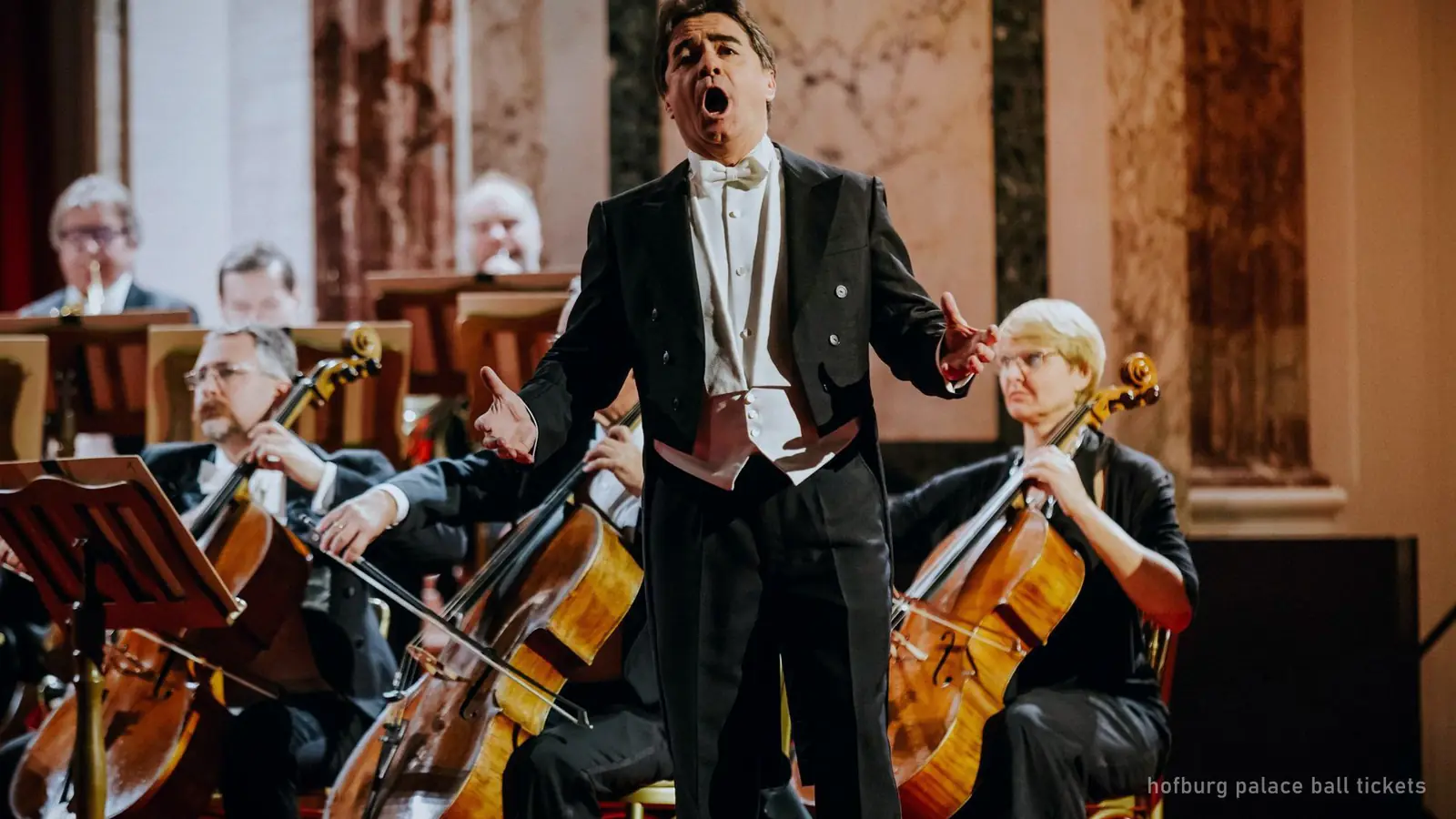
The Vienna Hofburg Orchestra plays a 90-minute programme of Mozart, the Strauss family, Emmerich Kálmán and Franz Lehár in the palace’s ceremonial halls, with up to forty musicians on stage alongside opera singers and ballet dancers. Tickets start at EUR 90 per person and the listing rates 4.7 from 215 reviews.
Two things to check before you pay. First the venue: the orchestra performs both at the Hofburg and at the Konzerthaus, and the booking page states that the meeting point varies with the option you select. Second the expectation: this is a ballroom, not the Musikverein, and the acoustics are generous rather than precise. The value-for-money sub-score on the listing is 4.4, the lowest figure in its breakdown, which is the reviewers’ polite way of saying the same thing.
What you are buying is an evening in rooms that are otherwise closed to you.
The ball season
Vienna’s ball season runs roughly from January to March, and the Hofburg is one of its principal venues. Several hundred balls take place across the city in those weeks; a dozen or so are the ones people have heard of.
This is not a tourist show. A Vienna ball is a real social event with a real structure: an opening by debutante couples, a formal programme, dancing until the small hours, a midnight quadrille that everyone joins and nobody can do, and breakfast. Tickets are sold to the public and visitors are genuinely welcome — but you are a guest at somebody else’s institution, not an audience.
The dress code is absolute and enforced at the door. Men are typically required to be in white tie — tails — or in some cases black tie or an Austrian uniform; women in a full-length evening gown. Doormen turn people away. Formalwear hire is a functioning Vienna industry for exactly this reason.
Costs run well beyond the ticket. Budget for the ticket itself, a table reservation if you want somewhere to sit, hire or purchase of the outfit, and food and drink at event prices. Each individual ball publishes its own prices and its own code, and they differ enough that a dinner jacket acceptable at one will not get you into another. The organiser’s own page is the only source that matters.
The congress centre behind both
The rooms are operated as the Hofburg Vienna congress centre, which runs the Festsaal, the Zeremoniensaal, the Rittersaal, the Marmorsaal, the Grosser and Kleiner Redoutensaal and a set of smaller rooms.
Two practical consequences for an ordinary visitor. Parts of the palace close at short notice when an event takes them, which does not affect the museum route but does affect what you can walk past. And the Great Redoutensaal you will be sitting in is a 1990s interior: it burned down in November 1992 and was rebuilt by 1997 with wall and ceiling paintings by Josef Mikl rather than a reconstruction of the 1892 stucco.
Telling an official event from a tout’s
This is the part worth reading, because the palace’s name is the single most resold asset in Vienna.
Buy from the organiser or a named platform. Concerts have an identified orchestra and a booking page that names the venue and the room. Balls have an organising body — a profession, a university faculty, a charity — with its own website and its own ticket office.
Be suspicious of a street seller in period costume. They are on the Kohlmarkt and around Michaelerplatz every evening in season, selling concert tickets in a wig. Some are legitimate agents for real concerts; the pricing is rarely the best available and the venue is sometimes not the one the picture shows.
Check the room, not the building. “At the Hofburg” covers a great deal of ground. A ticket should tell you whether you are in the Festsaal, a Redoutensaal, or somewhere else entirely.
A ball ticket will state the dress code. If it does not, that is a signal.
If you only have a daytime
The cheapest music in the building is a Sunday morning. The Vienna Boys’ Choir sings the 9:15 mass in the Hofburgkapelle from September to June, seats start at EUR 14, and standing room is free from 8:30 a.m. It is a liturgy rather than a performance, and it has been happening in that chapel since 1498.