
informational Pillar guide 8 min read
The Hofburg's History and Architecture
Updated September 18, 2026
The Hofburg was begun in the thirteenth century and the last major wing was finished in 1913. That is the whole explanation for why it does not look like one building: it is not one building, it is six hundred and fifty years of one family adding rooms.
The castle underneath
The oldest part is the Schweizerhof — the Swiss Court — and a thirteenth-century fortified castle is what is under it. The Habsburgs took Vienna in 1278, after Rudolph beat Ottokar II of Bohemia at the Battle on the Marchfeld, and the castle they moved into is the seed the rest grew from.
You can still read the shape. The Schweizerhof is small, irregular and defensive in plan, and the red-and-black Swiss Gate that leads into it is a Renaissance front on a medieval structure. Walk through it and you are in the oldest courtyard in the complex, with the Imperial Treasury on one side and the Hofburgkapelle — the palace chapel, whose choir has sung there since 1498 — on the other.
Each ruler’s wing
What follows is the pattern that gives the palace its shape: almost every serious Habsburg built something, and almost nobody demolished anything.
The Stallburg went up around 1558–1565 as a residence for Archduke Maximilian, later Maximilian II. From 1659 to 1776 it housed Archduke Leopold Wilhelm’s picture collection — the Stallburg gallery, which is the core of the later Kunsthistorisches Museum — and then became the imperial stables. The Lipizzaners are in it today.
The Amalienburg and the Leopoldine Wing followed in the sixteenth and seventeenth centuries, adding residential space around what became the In der Burg courtyard.
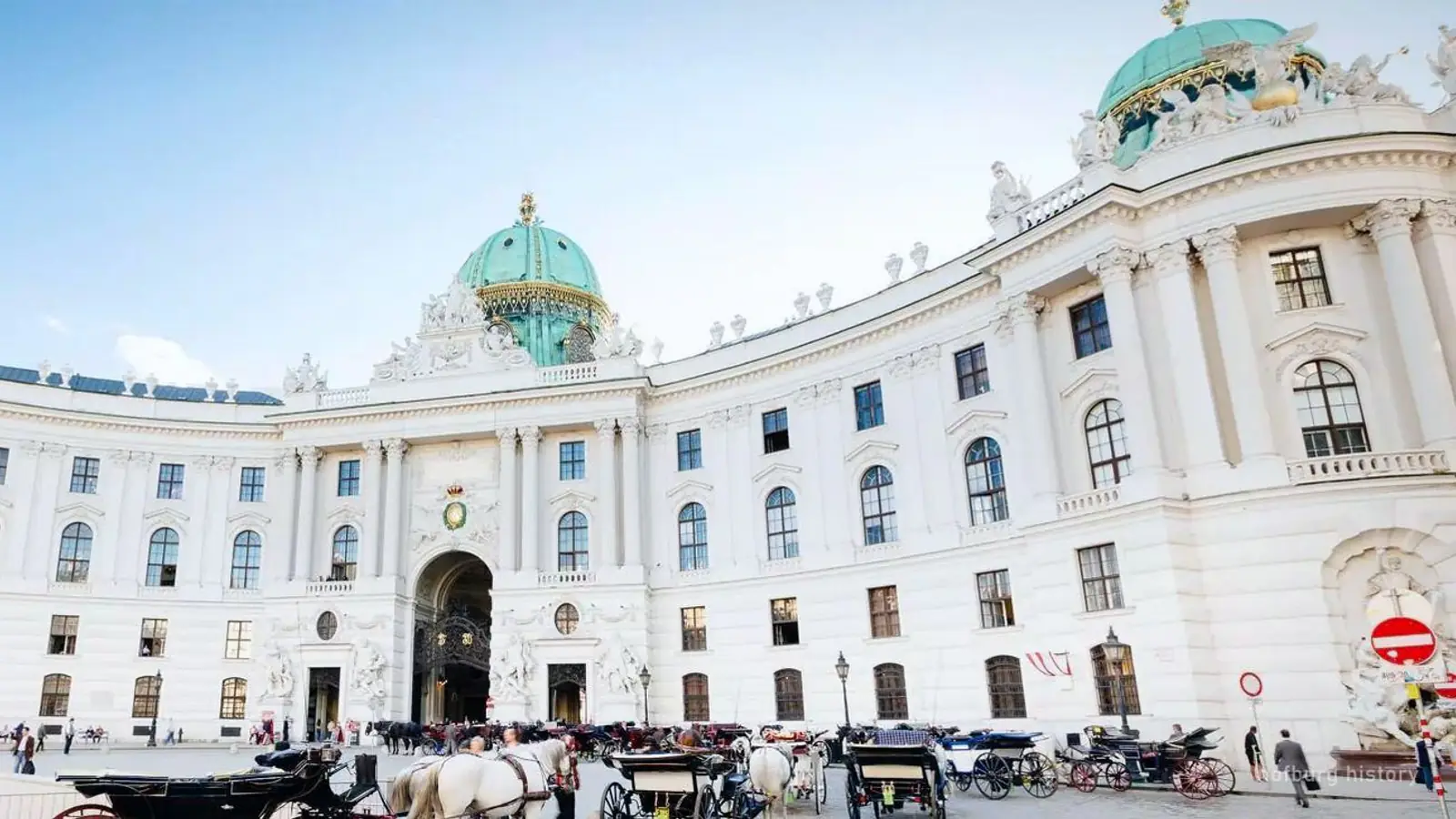
Charles VI, in the 1720s and 1730s, is the reason the palace looks baroque from Josefsplatz. He commissioned the Winter Riding School from Joseph Emanuel Fischer von Erlach, built between 1729 and 1735, and the Court Library — the State Hall — on the same square. Fischer von Erlach also drew the Michaelertrakt, the curved wing with the green dome facing the inner city.
The Michaelertrakt is the best illustration of how this palace was actually built. The design is eighteenth century. Construction started and stalled, because the Old Burgtheater that was supposed to be demolished to make room for it was left standing instead. The façade and the gate stayed unfinished for over a century, and were only completed during the building of the Ringstraße in the late nineteenth century. The entrance most visitors walk through was drawn about a hundred and fifty years before it was finished.
The Kaiserforum that was never built
The most ambitious plan for the site was drawn in the later nineteenth century and only about half of it exists.
The idea was an imperial forum: a vast symmetrical composition straddling the Ringstraße, with two matching museum buildings on one side — the Kunsthistorisches and the Naturhistorisches, which were built and stand facing each other across Maria-Theresien-Platz — and two matching palace wings on the other, enclosing Heldenplatz.
Only one palace wing was built. The Neue Burg, finished in 1913, is the curved building along Heldenplatz. Its mirror image was to stand roughly where the Volksgarten is. The First World War and the collapse of Austria-Hungary ended the project, and the Volksgarten — Vienna’s first public park, opened in 1823 — survived because the empire did not.
So Heldenplatz is a half-finished room. The square feels enormous partly because the wall that was meant to close it is missing.
1918: palace to republic
Charles I issued a proclamation on 11 November 1918 recognising Austria’s right to determine its own future and renouncing any part in affairs of state. He never formally abdicated, but that is the date the dynasty ends.
What happened to the building afterwards is the interesting part: nothing was demolished and nothing was left empty. The republic moved in. The palace was distributed among museums, a library, a riding school, a chapel, a conference business and the head of state, and that is broadly the arrangement today.
Heldenplatz then had the worst afternoon in the building’s history. On 15 March 1938 Hitler addressed the crowd from the Neue Burg balcony to announce the Anschluss. The balcony is not part of any museum route and is not open to visitors; the square below it is public and free.
Fire, three times
The palace has burned down in parts repeatedly, and the dates are worth having.
1668: Emperor Leopold I had to be rescued; restoration ran from 1668 to 1681 and added a storey.
1848: fire during the Vienna Rebellion burned part of the imperial library, destroying museum collections and notes in the zoological cabinet.
26–27 November 1992: a large fire in the Redoutensäle on Josefsplatz destroyed the Great Redoutensaal, bringing down its 1892 stucco ceiling and the baroque roof timbers. The Spanish Riding School and the National Library were both threatened and both saved. The rebuild was complete by 1997, with new wall and ceiling paintings by Josef Mikl instead of a reconstruction.
What it is used for now
All at the same time, in the same complex:
| Part | Use |
|---|---|
| Leopoldine Wing | Office of the Federal President of Austria |
| Reichskanzleitrakt and Amalienburg | Imperial Apartments and Sisi Museum |
| Schweizerhof | Imperial Treasury and the Hofburgkapelle |
| Josefsplatz side | The State Hall of the National Library, the Redoutensäle |
| Stallburg and Winter Riding School | The Spanish Riding School |
| Neue Burg | Weltmuseum, Imperial Armoury, historic instruments, Ephesos Museum |
| Albertina, southern tip | An art museum in Duke Albert’s palace |
| Ceremonial halls | Hofburg Vienna congress centre, concerts and the ball season |
Seven operators sell tickets inside it. That is not disorganisation — it is what happens when a building outlives the institution it was built for and gets given to whoever needs a room.