
Walking the Hofburg Courtyards for Free
Updated September 18, 2026
You can walk through the middle of the Hofburg without buying anything. The courtyards are a public right of way and they connect Michaelerplatz on one side to Heldenplatz on the other, passing the oldest part of the palace on the way. It takes about fifteen minutes, it costs nothing, and it is the single best way to understand how the complex is put together before deciding what to pay for.
In der Burg, and the monument in the middle
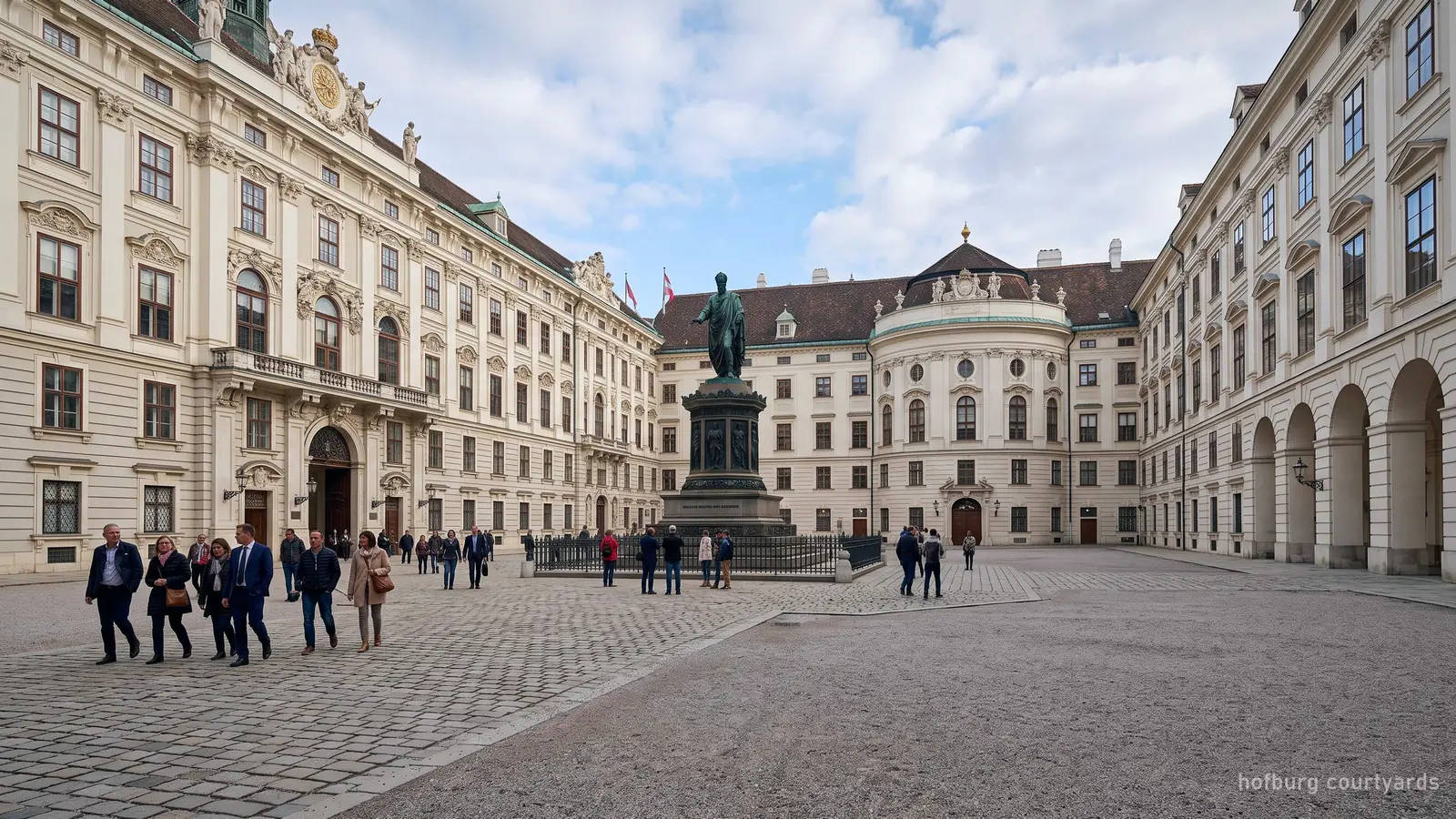
Go through the domed gateway at Michaelerplatz and you come out into In der Burg, the largest of the inner courtyards. It is enclosed on all sides by wings from different centuries — the Amalienburg on one side, the Leopoldine Wing on another, the Reichskanzleitrakt on a third — which makes it the clearest single view of how the palace accumulated. In the middle stands the monument to Emperor Franz I, in Roman dress. Behind the Leopoldine Wing's windows is the office of the Federal President of Austria, which is worth a moment's thought: the head of a republic works in the rooms of the family the republic replaced. The entrance to the Imperial Apartments, the Sisi Museum and the Silver Collection is off this courtyard. So is the ticket office.
The Swiss Court and its red-and-black gate
From In der Burg, a gateway leads into the Schweizerhof — the Swiss Court — and this is the oldest part of the Hofburg. A thirteenth-century fortified castle is underneath it, which is why the courtyard is small and irregular where everything around it is grand and symmetrical. The Swiss Gate itself is the thing to stop at: a Renaissance portal painted red and black, dated 1552, carrying the titles of Ferdinand I. It is the most photographed object in the complex that does not require a ticket. Off this courtyard are two of the most important doors in Vienna: the Imperial Treasury, holding the crowns, the regalia and the Holy Lance, and the Hofburgkapelle, the palace chapel.
The chapel in the Swiss Court
The Hofburgkapelle is Gothic in its bones and it has had a working choir since 1498, when Emperor Maximilian I signed a letter instructing his court to employ a singing master, two basses and six boys. That institution still sings. Every Sunday from September to June the Vienna Boys' Choir performs the 9:15 mass here with members of the Vienna State Opera orchestra and men's chorus. Seats run from EUR 14 to EUR 52 and standing room is free, released at 8:30 in the morning. So there is a free way into a room in the Swiss Court, once a week, to hear the oldest musical institution in the building do the job it was created for. Our [chapel page](/guides/burgkapelle-vienna-boys-choir) has the detail.
How the courtyards connect the wings
The useful mental model: the Hofburg is not a building with corridors, it is a set of buildings around yards. Almost nothing connects internally. Getting from the Imperial Apartments to the Imperial Treasury means going outside and crossing a courtyard; getting to the Neue Burg museums means crossing Heldenplatz. That has two consequences for a visit. First, you will be outdoors repeatedly, which matters in January and in July — bring a coat you are willing to check at each cloakroom separately, because they do not share one. Second, the walk between tickets is itself the best free sightseeing on the site.
The best order to walk them
West to east, ending in the open, so the space expands as you go. Start at Michaelerplatz, with the Roman excavation in the middle of the road and the Loos House facing the palace. Go through the Michaelertor under the green dome. Cross In der Burg, past the Franz I monument, and look up at the different centuries meeting at the corners. Turn into the Schweizerhof through the red-and-black Swiss Gate. Stand in the smallest courtyard in the palace and notice that it is the oldest. Come out onto Heldenplatz, which is enormous and half-finished: a second Neue Burg was meant to close it and the First World War stopped the project. The balcony on the Neue Burg is where Hitler spoke on 15 March 1938; it is not open to visitors and the square below is public. Finish in the Burggarten or the Volksgarten, both free, both with somewhere to sit. Fifteen minutes at a walk, forty if you stop. Nothing on that route costs anything.
When the courtyards are open
As a public route rather than a museum, so broadly during the day and into the evening, rather than to museum hours. Gates close overnight. One thing to expect: parts of the complex close at short notice when the Hofburg Vienna congress centre has an event in the ceremonial halls. That does not affect the museum route or, usually, the walk described above, but it explains the occasional barrier.
Frequently asked questions
Can you walk through the Hofburg courtyards for free?
Yes. The courtyards are a public route connecting Michaelerplatz to Heldenplatz, and walking through them costs nothing.
What is the Swiss Court?
The Schweizerhof, the oldest part of the Hofburg, built over a thirteenth-century castle. Its red-and-black Swiss Gate dates from 1552, and the Imperial Treasury and the palace chapel open onto it.
How long does the walk take?
About fifteen minutes end to end, or forty if you stop at the Swiss Gate and the Franz I monument.
Is the Hofburg chapel free to enter?
Standing room at the Sunday 9:15 mass, sung by the Vienna Boys' Choir from September to June, is free and released at 8:30 a.m. Seats cost from EUR 14.
Sources