
The Volksgarten: Vienna's First Public Park
Updated September 18, 2026
The Volksgarten sits on the north-western side of the Hofburg, between the palace and the Ringstraße, and it was Vienna's first public park — opened on 1 May 1823. It is free, it is open air, and it holds three things worth crossing the square for: a rose garden of more than 3,000 bushes, a full-size reconstruction of a Greek temple, and the city's memorial to Empress Elisabeth. It is also the obvious place to sit down after the Imperial Apartments.
A park built on a demolition
In 1809, after France's victory over Austria in the War of the Fifth Coalition, French troops occupying Vienna destroyed the Burgbastei — a major defensive bastion of the Hofburg. Rather than rebuild it, the court redesigned the whole area. The court architect Ludwig Gabriel von Remy planned what is now Heldenplatz, flanked by two parks: the Volksgarten on one side and the Burggarten on the other. Franz Antoine the Elder did the planting. The park opened on 1 May 1823, and two coffee houses opened with it, both owned by Peter Corti; they drew crowds and hosted concerts by Joseph Lanner and Johann Strauss I. It was nearly built over. The Volksgarten was to be replaced by the Kaiserforum, with a mirror image of the Neue Burg standing where the roses are. The First World War and the collapse of Austria-Hungary killed the plan.
The rose garden
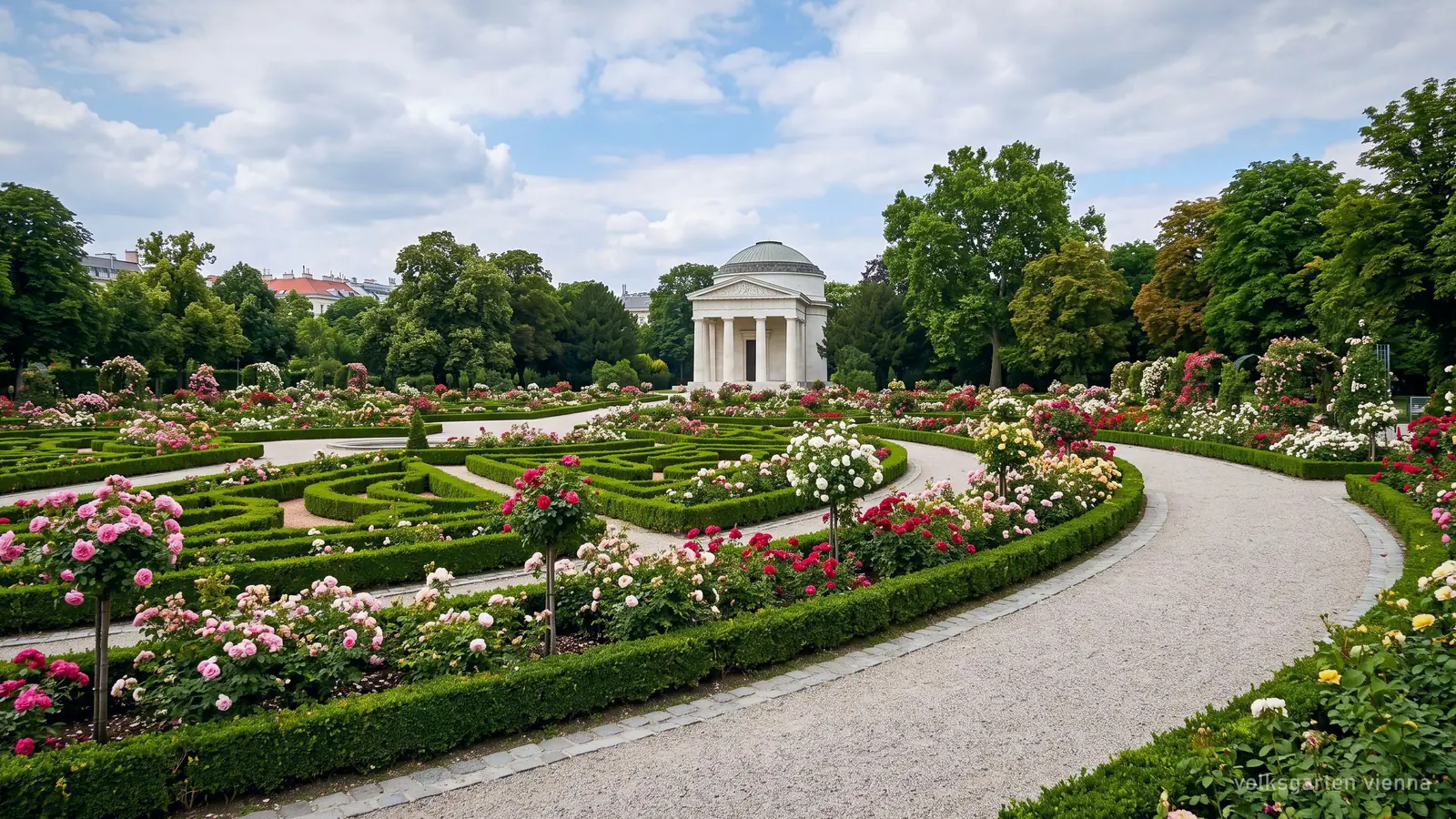
Between the entrance near the Burgtheater and the Grillparzer monument, and the reason a good share of the park's visitors come. It holds more than 3,000 rose bushes representing over 200 varieties. The central beds are enclosed by boxwood hedges and hold most of the roses; the perimeter has the widest range, arranged in successive rows of standard roses and then climbing roses. Most varieties are labelled, which makes it a working collection rather than decoration. Roses being roses, timing decides everything. The main flush is late spring into early summer, with a second showing later in the season; in winter the beds are cut back and the park is a different, barer place.
The Theseus Temple
The small Greek temple in the middle of the park is a reconstruction of the Temple of Hephaestus in the Agora at Athens, designed by Pietro Nobile and built before the park itself opened. It went up for one purpose: to house Antonio Canova's marble group of Theseus slaying a centaur, originally commissioned for Napoleon and acquired by Emperor Franz I after Napoleon's fall. The statue left in 1890 for the Kunsthistorisches Museum, where it stands on the main staircase. The catacombs underneath the temple once held the emperor's antiquities and were open to the public, until damp forced their removal. The temple was renovated in 2010 and now serves the Kunsthistorisches Museum as an exhibition space — so it is occasionally open, with a single contemporary work inside.
The Sisi memorial
At the park's edge stands the monument to Empress Elisabeth, unveiled in the presence of Franz Joseph, her widower. The seated figure overlooks a pond and the rose garden. It is the counterpart to the museum inside the palace: a public, civic memorial rather than a curated exhibition, and it is free to stand in front of. The park holds several other monuments. There is the Grillparzer monument of 1889 by Carl Kundmann, a Lasa marble memorial to the dramatist with scenes from his plays; a bronze of a young athlete from 1921; the Raab monument of 1967 to the chancellor who secured Austrian independence in 1955; and an X-shaped memorial to the victims of Nazi military justice — Austrian deserters and conscientious objectors who were executed. Two fountains, the Volksgarten-Brunnen of 1866 and Tilgner's Triton and Nymph fountain of 1880, complete the set.
Two designs in one park
Walk it and you will notice the halves do not match. The side facing the Hofburg is an English landscape park, with trees in a loose avenue. The side facing the Ringstraße is a French baroque garden, laid out with architectural rigidity. That is deliberate: the park was extended when the Ringstraße was built, the wall separating it from Heldenplatz was removed, and the new outward section was designed in a different idiom. Franz Antoine the Younger expanded it again between 1883 and 1884, and Friedrich Ohmann redesigned that section between 1903 and 1907.
Hours, entry and one point of confusion
Entry is free and the park keeps public-park hours, closing overnight and opening earlier in summer than in winter — the gates carry the current times. The point of confusion is the name. Corti's old coffee house in the park was converted into a nightclub in 1974, and 'Volksgarten' in Vienna often means that club rather than the park. If someone tells you the Volksgarten opens at eleven at night, they are talking about a different place with the same address.
Frequently asked questions
Is the Volksgarten free?
Yes. It is a public park with free entry, and has been since it opened on 1 May 1823.
When do the roses flower in the Volksgarten?
The main flush is late spring into early summer, with a second showing later in the season. The garden holds over 3,000 bushes across more than 200 varieties.
Is the Sisi monument in the Volksgarten?
Yes. The memorial to Empress Elisabeth stands at the edge of the park, overlooking a pond and the rose garden, and was unveiled with Franz Joseph present.
Can you go inside the Theseus Temple?
Sometimes. It was renovated in 2010 and is used by the Kunsthistorisches Museum as an exhibition space, so it opens for shows rather than continuously.
Sources