
informational 6 min read
The Wachau Valley and Melk Abbey from Vienna
Updated September 18, 2026
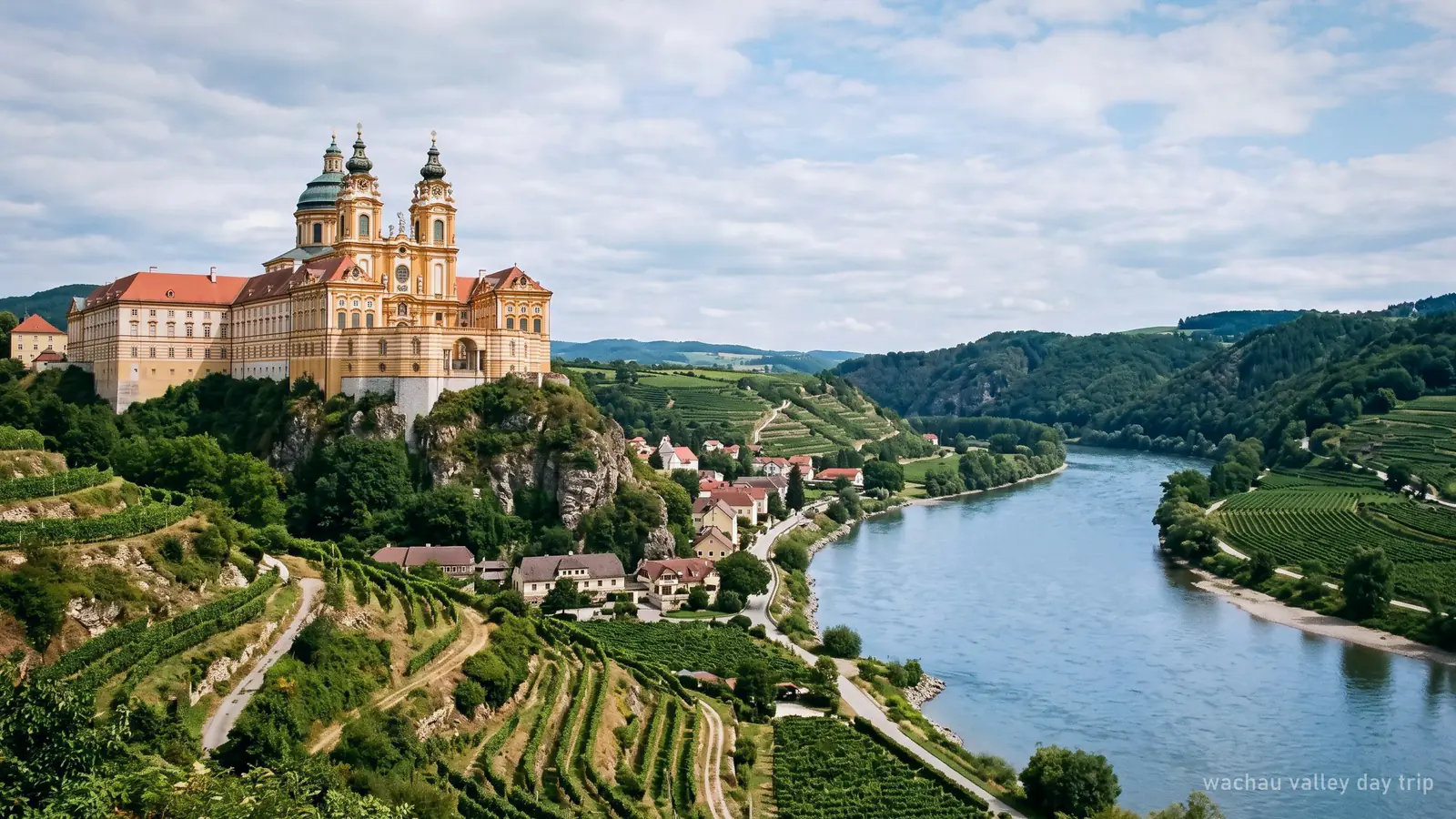
The Wachau is the stretch of the Danube between Melk and Krems: terraced vineyards on both banks, a run of villages that have not changed shape in centuries, and a Benedictine abbey standing on a rock above the river. It is a UNESCO World Heritage cultural landscape and it is the day trip most visitors to Vienna regret skipping.
The Vienna Tourist Board’s own description of it is a cruise through the valley taking in Melk Abbey, “towering above the river”, and the vintners’ villages of Spitz, Dürnstein and Weissenkirchen.
Melk Abbey
A working Benedictine monastery, founded in the eleventh century when Margrave Leopold II gave one of his castles to the Benedictines, and rebuilt in the eighteenth century into the baroque complex that is there now.
Three things inside are worth the ticket: the library, the marble hall and the abbey church. The library is the one people photograph — a two-storey baroque room of medieval manuscripts, and the reason Umberto Eco named a character in The Name of the Rose Adso of Melk.
The abbey survived the dissolution of monasteries under Joseph II and both world wars, and it still runs a school. It is not a ruin being shown to tourists; it is an institution that lets you in.
Train out, boat down, train home
This is the standard shape of the day and there is no better one.
Out to Melk by train. The journey is on the Western Line out of Vienna, the same line that runs to Linz and Salzburg.
The abbey in the morning. Two hours is about right, more if you take a guided tour.
The boat from Melk to Krems in the afternoon. This is the part that makes the day. The river service runs downstream through the whole of the Wachau, past Spitz, Weissenkirchen and Dürnstein, and takes roughly the middle of the afternoon.
Train home from Krems.
Do it in that direction rather than the reverse: downstream is faster, and it puts the abbey at the start when you have energy for a baroque library.
The boats are seasonal — check first
The single most important practical point on this page. The Danube passenger services through the Wachau are seasonal and thin out sharply outside the summer months. Outside the season the boat leg simply does not exist, and the day becomes a train to Melk and a train back.
Check the operator’s timetable for your date before you build a day around a sailing. This is also why the Wachau is a poor winter trip, and why our winter day trips page sends you elsewhere.
Dürnstein and the vineyards
Dürnstein is the village with the blue church tower that is on every photograph of the valley, and above it are the ruins of the castle where Richard the Lionheart was held prisoner in 1192–93 on his way back from the Third Crusade. The climb up to the ruin takes about half an hour and the view down the river pays for it.
The Wachau is also a serious wine region — Grüner Veltliner and Riesling on terraces that are hard to work and produce wines that are correspondingly expensive. If wine is the point of your trip rather than a bonus, you want a whole day in one village rather than the boat itinerary above, because the boat does not stop long enough to taste anything.
The vineyards are at their best in late summer and early autumn, when the terraces are green and the harvest is on. April brings the apricot blossom, which the valley is locally famous for.
Doing it as an organised tour
Tours from Vienna cover the Wachau with a coach, and they solve the timetable problem — no connections to miss, no seasonal boat to check. What they cost you is the boat itself on some itineraries, and the ability to stay in Dürnstein an extra hour because you like it.
If you are confident with timetables, do it independently. If the idea of a missed connection in a village with an hourly train would ruin the afternoon, take the tour.
How long to allow
All of it. This is a full day from about eight in the morning to seven or eight at night, and it does not compress. Do not try to fit the Hofburg into the same day.