
informational 6 min read
The Neue Burg Collections at the Hofburg
Updated September 18, 2026
The Neue Burg is the long curved wing on Heldenplatz, the last thing the Habsburgs built at the Hofburg and the part that was never finished as planned. Behind its balcony are four museums and a fifth institution, and between them they are the most under-visited serious collections in central Vienna.
On an August afternoon when the queue at Michaelerplatz runs out into the square, you can have the armoury to yourself.
What is in there
Five things share the wing:
- The Weltmuseum Wien, Austria’s largest anthropological museum, with more than 400,000 objects.
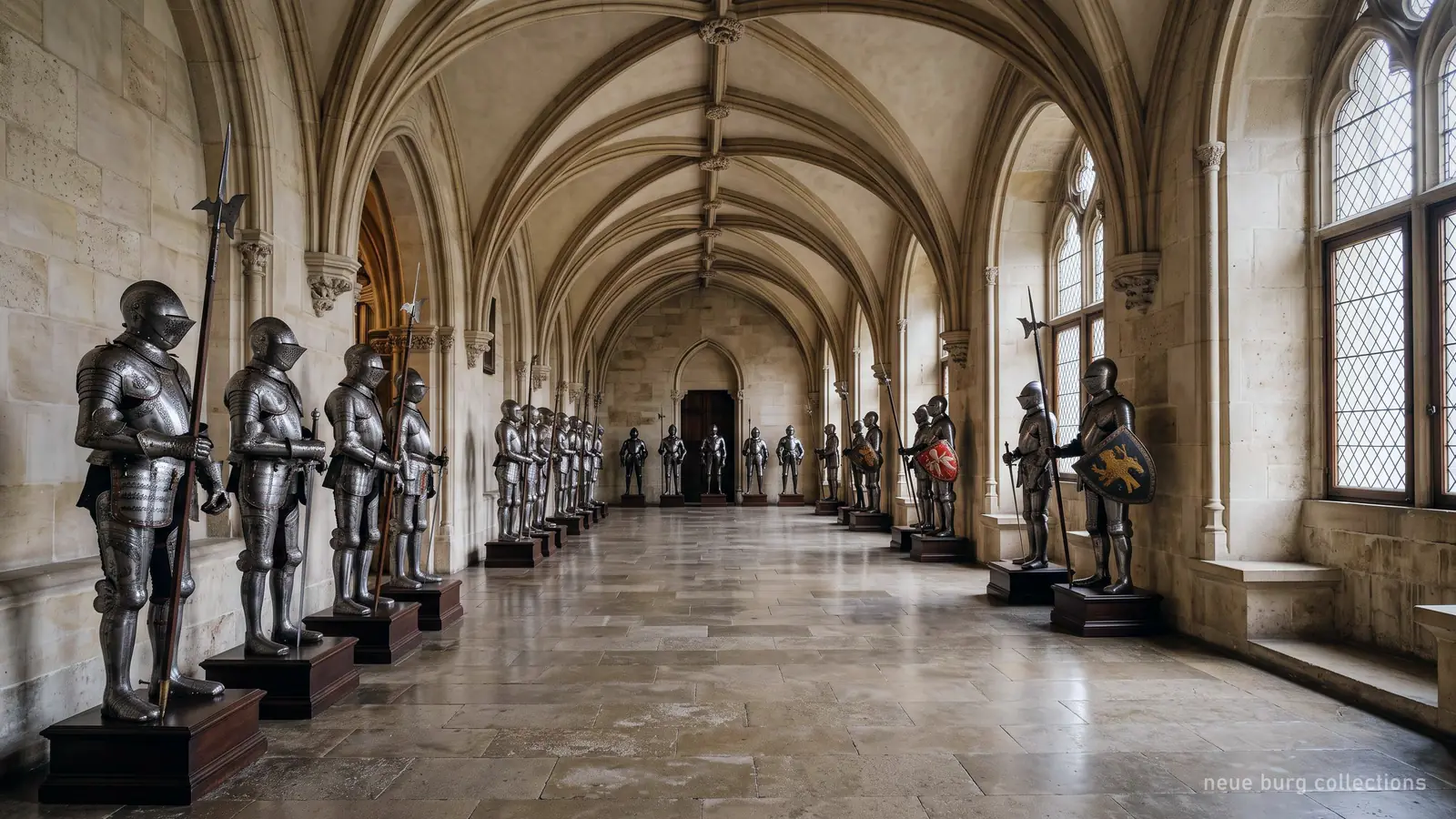
- The Imperial Armoury — the Hofjagd- und Rüstkammer, the court hunting and armour collection.
- The Collection of Historic Musical Instruments.
- The Ephesos Museum, holding Austrian excavation finds from Ephesus.
- The Haus der Geschichte Österreich, the museum of modern Austrian history, which is a separate institution.
The Imperial Armoury
One of the most important collections of its kind anywhere, and not a warehouse of anonymous breastplates. What distinguishes it is provenance: these are court pieces, so a great many of them can be attached to a named Habsburg, which turns the collection into a portrait gallery in steel.
The tournament armour is the part that surprises people — enormous, fluted, purpose-built for a single kind of ritual combat, and closer to sporting equipment than to anything used on a battlefield. The hunting weapons are the other half of the collection’s name and the half most visitors walk past.
The Collection of Historic Musical Instruments
The strongest argument for the Neue Burg ticket, and the one nobody expects. It holds the largest collection of Renaissance instruments in the world, and a run of keyboard instruments associated with the composers who worked in this city.
The point is not that the instruments are beautiful, though they are. It is that you can see what the music was written for — that a Viennese fortepiano of the 1790s is a different machine from a modern concert grand, and that the difference explains things about Mozart that a recording cannot.
One ticket, three museums
Here is the fact that makes the wing worth a morning. The Weltmuseum’s own visitor page states that its admission “admits you to the Imperial Armoury and the Collection of Historic Musical Instruments of the Kunsthistorisches Museum.”
That is three museums for EUR 16 adult, EUR 12 reduced, EUR 15 with a Vienna City Card, and free for anyone under 19 — under-19s are admitted free to all the federal museums.
Two caveats. The Ephesos Museum is not named in that sentence, and the Kunsthistorisches Museum does not publish a standalone Ephesos price on its own page, so ask at the desk. And the Haus der Geschichte Österreich is a separate institution with its own admission.
If you intend to do the whole group and the main Kunsthistorisches Museum as well, the 7 Museums Pass at EUR 53 for 365 days covers the Neue Burg collections, the Weltmuseum, the Imperial Treasury, the Imperial Carriage Museum, the Theatermuseum and Ambras Castle in Innsbruck.
Opening hours
The Neue Burg museums are closed on Monday and open 10:00 to 18:00 on every other day, with a late evening — Tuesday for the Weltmuseum, Thursday for the Ephesos Museum. Check the specific collection you want, because the late nights do not line up.
The Monday closure is the one to plan around. On a Monday the Neue Burg is shut and the Imperial Apartments are open; on a Tuesday the Neue Burg is open and the Imperial Treasury is shut.
Why it is quiet even in August
Three reasons, and none of them is the quality of the collections.
The entrance is on Heldenplatz rather than Michaelerplatz, so the arriving crowd never passes it. The name means nothing to a visitor — “Neue Burg” is not on anybody’s list the way “Sisi Museum” is. And the collections are unfashionable: armour, early instruments and ethnography are not what a first trip to Vienna is sold on.
The consequence is that a EUR 16 ticket buys you three museums and empty rooms, about two hundred metres from a queue.
The balcony
Worth knowing, since people ask. The Neue Burg’s balcony is where Hitler addressed the crowd on Heldenplatz on 15 March 1938. It is not part of any museum route and it is not open to visitors. What you can do is stand on the square below it, which is free, and which the Heldenplatz page covers.